

What Happens If You Fail a Restaurant Health Inspection? A Florida Guide
What if a failed inspection doesn’t automatically mean your restaurant has to close? In Florida, what happens if you fail a restaurant health inspection depends on the findings and the instructions in the agency’s notice. Some issues call for correction and follow-up; conditions that pose an imminent threat to public health can lead to an emergency closure.
It’s understandable to worry about keeping the doors open, protecting your reputation, and meeting the regulator’s requirements. The inspection report can feel like a long list of problems, but it shows what needs attention. Review each finding, confirm what the notice requires, and don’t assume every violation has the same consequence.
This guide explains possible outcomes, how to prioritize and document corrections, and what to check about follow-up inspections or agency notices. Because the responsible agency and process can depend on your operation and license type, verify those details before acting. A clear, timely response can help you turn uncertainty into a practical plan.
Key Takeaways
- What happens if you fail a restaurant health inspection depends on the documented findings and the regulator’s applicable process, not one automatic outcome.
- Use the report to identify urgent safety concerns, clarify unclear findings, and confirm the required next steps.
- Keep one correction log with responsible staff, actions taken, dates, supporting records, and questions that still need answers.
- Check the written notice for follow-up inspections, response requirements, or other agency directions. Verify details with the regulator when needed.
- A compliance and inspection readiness review can help organize corrections and records when your team needs structured preparation.
What happens if you fail a restaurant health inspection in Florida?
An unfavorable inspection result doesn’t mean every Florida restaurant faces the same consequence. Next steps depend on what the inspector observed, which requirements apply to your establishment, and what the responsible agency directs you to do. If you’re asking what happens if you fail a restaurant health inspection, start by reviewing the report and any accompanying notice. Address hazards and follow the written instructions.
“Failed inspection” is often used informally for an inspection with violations or other findings that require a response. The phrase doesn’t tell you by itself whether the restaurant can continue operating or what enforcement may follow. Read each item carefully. Distinguish urgent food-safety concerns from routine maintenance or recordkeeping issues, and ask the agency to clarify anything you don’t understand. General food safety best practices explain the principles behind safe handling, preparation, and storage, but the inspection report and applicable requirements determine your response.
An inspection finding documents an observed condition or possible violation; formal enforcement action is a separate agency step that may impose a specific requirement or consequence. Don’t assume a finding automatically means closure, or that no action is required because the restaurant wasn’t closed during the inspection.
Does failing an inspection mean the restaurant must close?
Not automatically. Operating status depends on the documented findings, applicable requirements, and whether the agency has issued a formal order. There isn’t one closure threshold you can assume applies to every establishment. Follow any written instructions you receive. If the notice doesn’t make clear whether you may continue operating, contact the issuing agency before making assumptions.
Which Florida agency handles a restaurant inspection?
The regulator can depend on the establishment’s activity and license type. The Florida Department of Business and Professional Regulation (DBPR), including its Division of Hotels and Restaurants, is a key agency to verify for food-service establishments. The Florida Department of Health or another authority may be relevant in other circumstances. Confirm who oversees your specific operation rather than relying on the word “restaurant” alone.
Check the agency identified on the report or notice, then confirm that it matches your operation and license. If you’re unsure, ask which requirements apply and what action the agency expects. A compliance review can help Florida restaurant owners organize findings, corrections, and unresolved questions, but a consultant doesn’t replace regulator instructions or legal counsel when legal advice is needed.
How inspection findings, corrections, and follow-up usually fit together
Build your response around the written report, not guesses about what an inspector might expect. Read each finding, note the agency’s instructions, and clarify unclear wording with the issuing agency. Prioritize conditions that could affect food safety or create an immediate hazard. Address routine maintenance and recordkeeping observations too, but don’t let less urgent tasks distract from higher-risk corrections.
For each finding, assign a responsible person, record the corrective action, and note when it was completed. Keep supporting evidence together and confirm what the agency expects next. Reinspection timing, required proof, and follow-up procedures depend on the notice and the agency’s current process, so verify them directly rather than relying on a general timeline.
Florida has more than one agency involved in food safety. The Department of Health investigates foodborne illness outbreaks and related complaints, a role distinct from routine regulatory inspections. Check the agency named on your report so your response goes to the right place.
What should you do immediately after receiving the report?
Save the full inspection report and any related notice, order, or written instructions. Create a correction log and assign one person to manage each item. For example, a manager might coordinate an equipment repair while a shift lead records a staff procedure update. Contact the issuing agency if you’re unsure what a finding means, whether a specific action is required, or what comes next. Don’t assume a deadline or reinspection date that isn’t stated or confirmed.
What records help show that corrections were completed?
Build a record for each finding. Include dated corrective-action notes, the person responsible, completion dates, and relevant maintenance records or staff training documentation. Add invoices, service records, or photographs when they support the correction. Organize materials by finding so you can locate them quickly, and ask the agency which forms of evidence it accepts. Documentation helps you track open items; it doesn’t replace required agency verification.
If you want to check your systems before another inspection, use this Florida restaurant mock health inspection guide to see how a structured review can identify and organize gaps. For additional preparation, a Compliance & Inspection Readiness Package may help Florida operators organize corrections, records, and inspection-readiness steps.
What consequences can follow a failed restaurant health inspection?
There isn’t one standard consequence for every unfavorable inspection. What happens if you fail a restaurant health inspection depends on the findings, the establishment’s circumstances, and the regulator’s current rules. Outcomes may range from correcting an issue to further agency action. The Florida Department of Business and Professional Regulation (DBPR) explains different inspection dispositions, including results that call for follow-up and circumstances involving closure. Review the disposition recorded for your inspection and its related instructions.
An inspection result records the outcome of an inspection; a formal license action is a separate agency decision that may affect the establishment’s authorization to operate. Don’t treat the terms as interchangeable. A finding or unfavorable result alone doesn’t establish what action the agency will take.
Possible outcomes can include:
- Corrective action: The report identifies conditions to address, such as a food-handling concern or a maintenance issue.
- Follow-up: Depending on the findings and applicable procedure, the agency may require another inspection or other verification.
- Formal notice: Written agency communication may set out required steps or explain a decision. Read it carefully and confirm anything unclear.
- More serious agency action: Serious conditions or unresolved findings may lead to additional action under the rules that apply to the establishment.
These are categories, not a prediction about a particular case. Don’t infer a fixed deadline, penalty, or closure outcome from a general description. Use the report and official written communications to identify the specific requirements that apply.
When might follow-up or further agency action occur?
Unresolved findings or serious conditions can prompt further steps, but the applicable rules and circumstances matter. Check the report for the disposition, requested corrections, and any stated follow-up. If the notice doesn’t explain what happens next, contact the issuing agency for clarification. Keep a record of the response and instructions you receive.
When should an owner seek legal or compliance assistance?
Consider contacting an attorney if you receive formal enforcement, dispute a finding, face a hearing, or need advice about your legal rights. A compliance consultant addresses a different need: organizing records, reviewing operational readiness, and preparing corrections. Emerald Coast Restaurant Licensing Service provides compliance and licensing consulting, not legal representation, and can’t guarantee an agency outcome. For structured preparation, review the Compliance & Inspection Readiness Package.
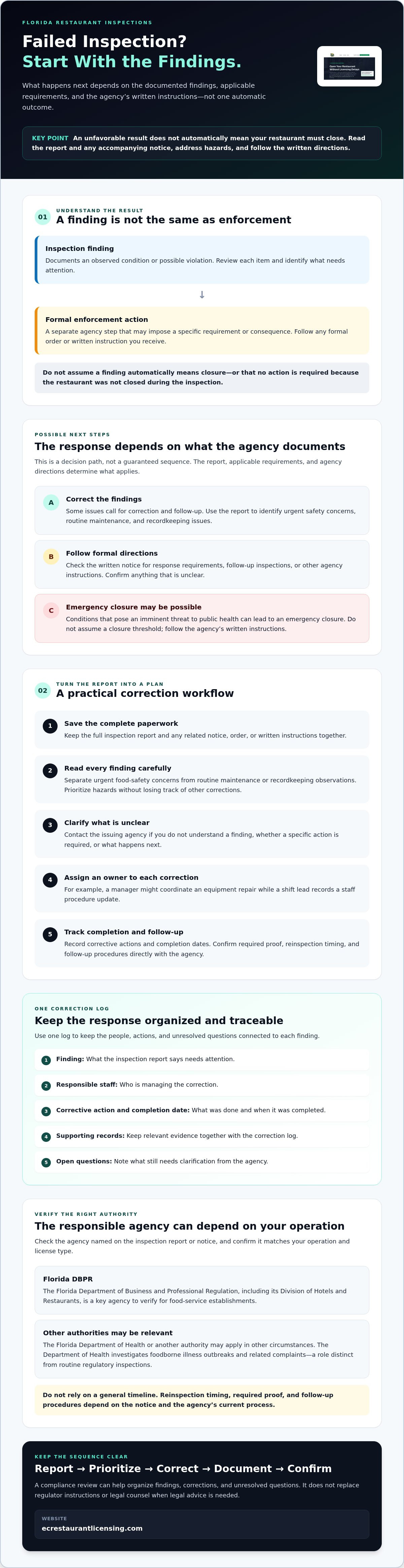
Steps to Handle a Failed Restaurant Health Inspection
Once you’ve reviewed the report, turn each finding into a tracked action. If you’re asking what happens if you fail a restaurant health inspection, work from the written instructions, address urgent documented risks first, and verify the follow-up process with the agency responsible for your establishment.
How should you prioritize and document corrections?
Use the report and agency directions to set priorities. Address the most urgent documented food-safety concerns first, using qualified operational advice where needed. Then work through the remaining findings so routine maintenance or paperwork tasks don’t disappear in the rush.
Keep one correction log for the whole team. For each finding, record:
- The report item and the person responsible for addressing it.
- What changed, when the correction was completed, and how it was checked.
- Supporting records, such as relevant service documentation or staff training notes.
- Any unresolved question and the agency’s response or instruction.
A shared log makes open tasks visible across shifts and helps prevent a handoff from leaving a correction unfinished. Before treating the response as complete, contact the appropriate agency to confirm follow-up arrangements, required evidence, or other next steps. Don’t rely on an assumed deadline or procedure.
How can Florida Panhandle operators prepare for the next inspection?
Owners in Walton, Okaloosa, and Bay counties should confirm which agency and license requirements apply to their specific operation. Don’t assume a nearby establishment with a similar menu or service model follows the same process. A preventive review can help organize records, spot operational gaps, and turn recurring findings into assigned tasks.
Use this Florida restaurant compliance audit guide to learn how a mock inspection can support a structured readiness review. If you’re a new operator and licensing setup is also part of the picture, the Florida restaurant opening roadmap covers that separate planning need.
When your team needs a structured review of corrections and readiness, explore inspection-readiness support from Emerald Coast Restaurant Licensing Service. Its consulting can help organize preparation and paperwork, but the regulator’s instructions remain the authority for your case.
When a Florida restaurant inspection-readiness consultant can help
After asking what happens if you fail a restaurant health inspection, you may also be deciding who can help you respond. The right support depends on the problem: your team can carry out routine corrections, the regulator can explain its report and process, legal counsel can advise on rights and disputes, and a compliance consultant can help organize operational preparation. These roles are different, and one doesn’t replace another.
Which kind of help fits the situation?
- Your restaurant team: Handle routine operational corrections that staff are qualified and authorized to make. Assign responsibility clearly so tasks don’t fall between shifts.
- The regulator: Contact the agency that issued the report for clarification about its findings, required actions, or official procedures. Its instructions control the agency process.
- Legal counsel: Seek an attorney’s advice about legal rights, disputed findings, formal proceedings, or how legal obligations apply to your circumstances.
- A compliance consultant: Consider consulting support if you need help organizing records, reviewing operational readiness, or coordinating licensing and paperwork preparation.
If you dispute a finding or the agency has started a formal proceeding, don’t treat consulting as a substitute for legal advice. Direct each question to the professional or agency equipped to answer it.
What can a compliance readiness package support?
Emerald Coast Restaurant Licensing Service’s Compliance & Inspection Readiness Package provides a structured path for preparation. A compliance review may help identify documentation gaps, organize relevant records, and clarify which operational items need attention. The business also supports licensing roadmaps and paperwork assistance. Discuss the specific work in light of your restaurant’s circumstances and the agency responsible for your operation.
Consulting can help you prepare a clearer, more organized response, but it can’t change an agency finding, replace official instructions, or guarantee a passing inspection or other regulatory outcome. The regulator remains responsible for its decisions.
For restaurants in Walton, Okaloosa, and Bay counties, gather the inspection report, any agency correspondence, and the questions your team still needs answered. Then discuss your inspection and licensing situation with Emerald Coast Restaurant Licensing Service to determine whether structured compliance preparation fits your needs.
Turn the Inspection Report Into a Clear Action Plan
A difficult inspection result doesn’t have one automatic outcome. What happens if you fail a restaurant health inspection depends on the findings, applicable requirements, and the agency’s instructions. Turn those instructions into assigned corrections, maintain clear records, and confirm any follow-up directly with the regulator.
If your team would benefit from structured preparation, Emerald Coast Restaurant Licensing Service offers a Compliance & Inspection Readiness Package for restaurant operators in Walton, Okaloosa, and Bay counties. Consulting can help organize readiness and paperwork, while the regulator remains responsible for official decisions.
Discuss inspection-readiness support with Emerald Coast Restaurant Licensing Service and identify a practical next step for your restaurant.
Frequently Asked Questions
What happens after a restaurant fails a health inspection?
What happens if you fail a restaurant health inspection depends on the findings and the regulator’s applicable process. Review the full report, identify each finding, and follow the issuing agency’s written directions. You may need to correct conditions, document the work, prepare for follow-up, or respond to further agency action. There’s no single outcome for every inspection. Confirm requirements and any deadlines directly with the regulator, especially if you received a formal order.
Can a restaurant stay open after failing a health inspection?
A restaurant may be able to stay open, but an unfavorable result alone doesn’t determine its operating status. The documented findings, license type, applicable requirements, and any formal order all matter. Read the report and accompanying notices carefully. If they don’t clearly state whether you can continue operating or what action is required, contact the issuing agency. Don’t rely on general online guidance when the agency has given case-specific instructions.
How soon does a restaurant have to correct inspection violations?
The correction timeline depends on the finding, the Florida requirements that apply, and the regulator’s written instructions. Don’t assume every issue has the same deadline or rely on a general timeline found online. Review the report, note any dates or required actions, and ask the issuing agency to clarify ambiguous instructions. Confirm current requirements with the relevant regulator before setting your schedule, particularly if a notice or order specifies a response.
What happens if a restaurant does not fix health inspection violations?
Unresolved findings may lead to additional agency follow-up or other action, depending on the conditions and applicable rules. The phrase “failed inspection” alone doesn’t establish the consequence. Keep a record of corrections attempted and any remaining barriers, and communicate with the regulator about required next steps. If you receive a formal enforcement notice, face a hearing, or dispute a finding, consider seeking advice from a Florida attorney.
Can a restaurant appeal a failed health inspection in Florida?
Whether you can challenge an inspection finding or later agency action depends on the specific decision and applicable procedure. Review the notice for instructions and deadlines, then contact the issuing agency if the process isn’t clear. If the issue involves formal enforcement, a hearing, or your legal rights, consult a Florida attorney. A compliance consultant may help organize inspection records and supporting documents, but can’t provide legal representation or legal advice.
Which agency handles restaurant health inspections in Florida?
The responsible agency can depend on the establishment’s activities and license type. Florida’s Department of Business and Professional Regulation is a key agency to verify for food-service establishments, but other authorities may have a role in particular circumstances. Check the agency identified on your license and inspection documents, and confirm directly that it oversees your operation. Don’t assume another restaurant’s regulator or process applies to your business.
Can a restaurant reopen after a health department closure?
Reopening depends on the authority that issued the closure, the conditions in its order, and confirmation that applicable requirements have been met. Don’t reopen based only on completed repairs, informal advice, or an assumption that the issue is resolved. Contact the issuing agency for clear instructions about required verification and approval. If the order or reopening process is disputed, consult legal counsel before acting.
Should I hire a consultant after failing a restaurant health inspection?
A compliance consultant may help organize findings and records, review operational readiness, and build a structured preparation plan. That support doesn’t replace the regulator’s instructions, legal counsel, or an agency decision, and it can’t guarantee a passing result. Contact the agency about official requirements and consult an attorney about disputes or formal proceedings. Restaurant operators in Walton, Okaloosa, and Bay counties can consider whether compliance support fits their preparation needs.