

Restaurant Sale Transaction Support in Florida: Securing Your 2026 Deal
Imagine reaching the closing table only to discover that an unresolved DBPR inspection issue has frozen the transfer of your 4COP liquor license. For many owners in the Florida Panhandle, this isn't a hypothetical fear; it's a common administrative reality that delays payouts and frustrates buyers. Securing professional restaurant sale transaction support Florida ensures that your deal doesn't stall at the finish line due to regulatory oversight. You've worked hard to build your brand, and you deserve a transition that respects both your time and your equity.
It's understandable to feel anxious about the timeline between a signed Letter of Intent and the actual operational handover. Many sellers struggle to distinguish between the duties of a traditional broker and a licensing consultant, which often leaves critical compliance gaps unplugged. We'll show you how to navigate this complex landscape to achieve a clean closing where the money moves and the licenses transfer simultaneously. This article provides a roadmap for expert valuation, proactive inspection readiness, and the strategic coordination required to secure your 2026 restaurant sale without the typical Florida red tape.
Key Takeaways
- Understand why Florida restaurant sales are regulatory events that require specialized expertise beyond the scope of a traditional business broker.
- Learn how to protect your equity by accounting for the "Licensing Premium" and securing comprehensive restaurant sale transaction support Florida.
- Master the critical timeline for DBPR and AB&T permit transfers to ensure your liquor license and food service permits move in sync with the financial closing.
- Implement a pre-sale compliance audit to identify and resolve health inspection issues before they can block your deal or devalue your business.
- Discover how integrating brokerage and licensing roadmaps into a single process minimizes the time from your initial Letter of Intent to a successful operational handover.
The Anatomy of a Florida Restaurant Sale: Beyond the Price Tag
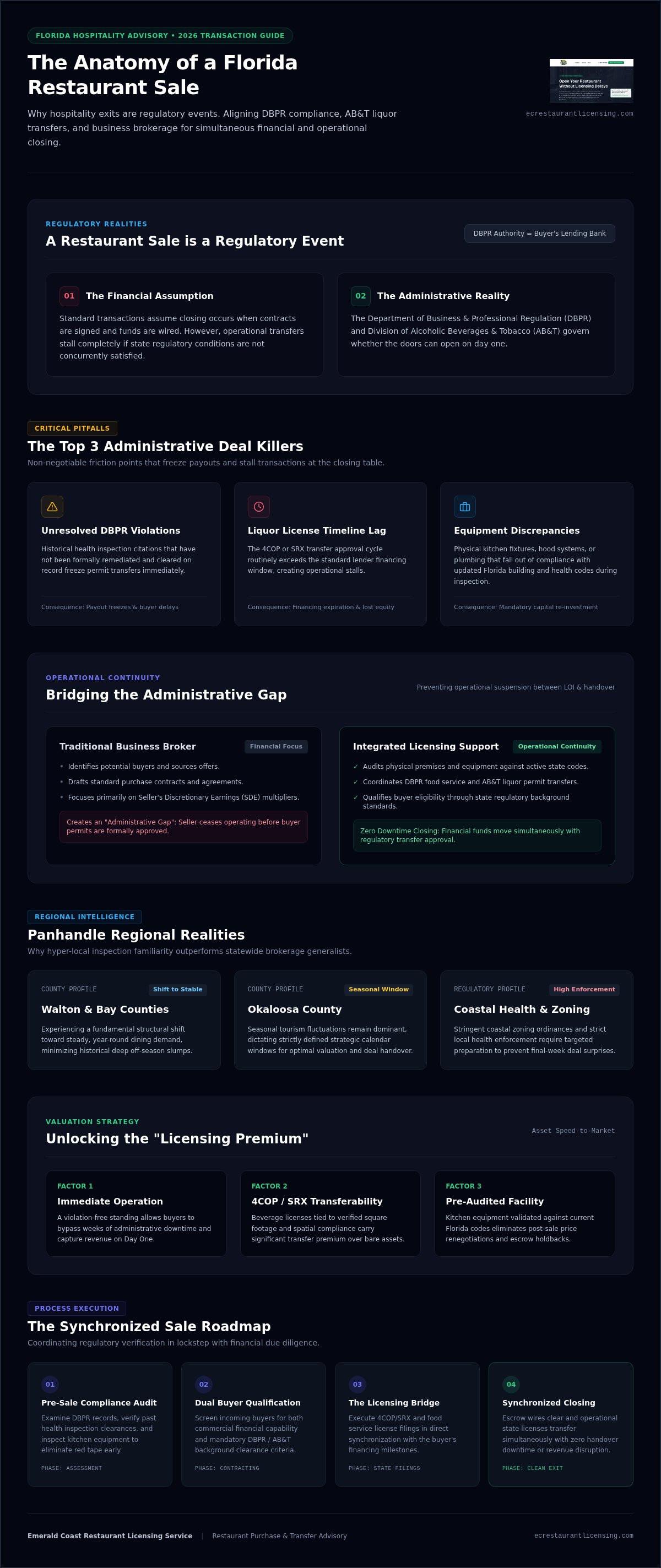
Closing a restaurant deal in Florida involves more than just a handshake and a wire transfer. It's a highly regulated event where the Department of Business and Professional Regulation (DBPR) holds as much power as the buyer's bank. While a general business broker transaction support focus is often limited to finding a buyer and drafting a contract, hospitality deals require specialized restaurant sale transaction support Florida to account for the physical and legal readiness of the facility. Without this focus, even the most lucrative financial agreements can collapse during the administrative phase.
The Unique Challenges of the Panhandle Market
The Florida Panhandle presents a distinct landscape for buyers and sellers in 2026. In Walton and Bay counties, we're seeing a shift toward year-round demand, yet seasonal fluctuations in Okaloosa County still dictate the best windows for valuation and handover. Coastal zoning laws and specific health regulations in these areas are notoriously rigid. A local Panhandle specialist outperforms a statewide generalist because they understand the specific inspectors, local ordinances, and market cycles that define our region's hospitality industry. This local foresight prevents "surprises" that often emerge during the final weeks of a sale.
The Brokerage vs. Licensing Distinction
It's vital to understand that finding a qualified buyer is only half the battle. Securing a license transfer is where the real complexity lies. A broker manages the transaction, but a licensing consultant manages the continuity of the business. If these two roles don't work in sync, you risk an "administrative gap" where the seller stops operating but the buyer hasn't yet received permit approval. To avoid these pitfalls, refer to The Ultimate Florida Restaurant Opening Roadmap: A 2026 Guide for a detailed look at the regulatory milestones you'll face.
Administrative delays are the primary "deal killers" in today's market. While financial disagreements are usually solved through negotiation, the following issues are often non-negotiable without expert intervention:
- Unresolved DBPR Violations: Past health inspection issues that haven't been formally cleared.
- Liquor License Timelines: The 4COP/SRX transfer process often takes longer than the financing window.
- Equipment Discrepancies: Kitchen assets that don't meet current Florida codes at the time of transfer.
Emerald Coast Restaurant Licensing Service bridges this gap by integrating our Restaurant Brokerage Services with deep regulatory expertise. We don't just find a buyer; we ensure the facility is compliant and the licenses are ready for a seamless handover. By utilizing our Restaurant Purchase & Transfer Package, both parties move forward with the confidence that the operational transition will be as clean as the financial one.
Strategic Valuation and Buyer Qualification
Valuing a business isn't just about the multiplier of your Seller's Discretionary Earnings. In the Florida hospitality market, your regulatory standing is a tangible asset. If your facility meets all current DBPR food service licensing requirements, you're offering a buyer something more valuable than kitchen equipment: speed to market. This is where specialized restaurant sale transaction support Florida becomes indispensable. It helps identify and quantify these hidden value drivers before you ever list the property for sale.
Determining the Licensing Premium
A "Licensing Premium" represents the value of immediate operational readiness. For a buyer, taking over a restaurant with a current, violation-free license means they avoid the weeks of downtime often associated with new permit approvals. This premium is especially high for establishments holding 4COP or SRX liquor licenses. Since these licenses are often tied to specific square footage or location requirements, their transferability adds significant weight to the total transaction value. Selling a "clean" license isn't just about compliance; it's a strategic pricing move that reflects the business's ability to generate revenue from day one.
The Buyer Qualification Checklist
Financial capability is only the first hurdle. In Florida, a buyer must also pass rigorous DBPR and AB&T background checks to hold a license. If a buyer has a criminal history or financial red flags that disqualify them from holding an alcohol license, the deal will fail during the administrative phase. You shouldn't wait until the due diligence period to discover these issues. A proactive approach involves vetting buyers for more than just their bank balance before you sign a Letter of Intent (LOI).
- Criminal Background Verification: Ensure all principals are eligible for Florida licensure.
- Liquor License Eligibility: Confirm the buyer meets the specific requirements for 4COP or SRX transfers.
- Operational Understanding: Verify the buyer understands the restaurant ownership change Florida process to avoid timeline friction.
Marketing your establishment in the Panhandle requires targeting investors who value the stability of Walton and Bay counties. By vetting buyers for regulatory eligibility early, you protect your time and ensure a smoother path to closing. If you're unsure how your current compliance status affects your asking price, getting an expert restaurant valuation can provide the clarity needed to attract serious, qualified investors.
The Licensing Bridge: Transferring DBPR and AB&T Permits
The transition of ownership in a Florida restaurant is a delicate administrative dance. While the financial closing marks the end of the buyer's search, it triggers a critical window for license transfers. Without dedicated restaurant sale transaction support Florida, many owners find themselves in a regulatory limbo where the business is legally sold but cannot legally serve a single meal. This section outlines how to bridge that gap between the sales contract and operational permits.
DBPR License Transfer Protocols
The process begins with the "Change of Ownership" application filed with the Department of Business and Professional Regulation. This isn't a mere notification; it's a full application requiring proof of possession, such as a signed lease or deed, and specific facility details. Common errors, like mismatched tax IDs or incomplete floor plans, can reset your processing timeline and delay your opening day.
A strategic "Licensing Roadmap" is essential to avoid the dreaded 30-day "dark period." In Florida, operating without a current license in your name is a violation, yet waiting for the state to process paperwork after closing often leads to weeks of lost revenue. We coordinate the submission so the buyer's permit is ready to activate the moment the seller's permit is retired. For those managing complex transitions, our Florida Restaurant License Renewal Help: Your 2026 Compliance Guide offers deeper insights into staying current during these shifts.
Alcohol License Continuity
Managing alcohol permits adds another layer of complexity. The Florida Division of Alcoholic Beverages and Tobacco (AB&T) distinguishes strictly between quota licenses and SRX (special restaurant) licenses. A quota license is a transferable asset that moves with the sale, while an SRX license is tied to the specific operations and seating capacity of the venue. Both require precise filings to avoid service interruptions.
To keep the bar operational during the transfer, we utilize temporary permits. These allow the buyer to continue service while the permanent license remains in "Pending" status, preventing a total shutdown of high-margin beverage programs. For complex sales involving multiple license types, the Alcohol License Guidance Package is a necessity to ensure every permit aligns with the new ownership structure. This proactive coordination ensures that your 2026 deal doesn't just close on paper; it remains fully operational from day one.
Due Diligence: Compliance Audits and Inspection Readiness
Due diligence in a hospitality transaction often stops at the profit and loss statement. While financial health is vital, the physical and regulatory state of the commercial kitchen determines if the buyer can actually open for business. Sophisticated buyers prioritize the "Health Inspection History" above almost any other operational metric. Engaging professional restaurant sale transaction support Florida allows sellers to identify and rectify physical red flags before they become deal-breaking liabilities.
The Pre-Sale Compliance Audit
A financial audit verifies where the money went, but a "Mock Health Inspection" reveals where the deal might fail. This audit mimics the rigor of a state inspector, focusing on critical violations that could lead to an "Administrative Complaint" or a stop-sale order. Finding these issues early prevents them from appearing on public DBPR or Sunbiz records, which can permanently tarnish a brand's reputation during the sale process.
Our Florida Restaurant Mock Health Inspections: A Guide to Compliance Audits provides a detailed checklist of what to look for. In the Panhandle, coordinating with health departments in Walton and Okaloosa counties requires a nuanced understanding of local enforcement styles. We focus on specific high-risk areas:
- Plumbing Integrity: Identifying cross-connection issues and grease trap compliance in older coastal buildings.
- Temperature Control: Verifying refrigeration performance and the accuracy of temperature logs.
- Sanitation Standards: Ensuring floor, wall, and ceiling finishes meet current Florida sanitation codes.
Lease and Permit Coordination
The lease agreement must be scrutinized to ensure it explicitly allows for the transfer of the specific permits required for your restaurant concept. In Bay County, reviewing the "Certificate of Use" is a non-negotiable step in the due diligence process. Many first-time buyers make the dangerous assumption that a permit automatically runs with the land; in reality, licenses are entity-specific and require a fresh application and inspection for every ownership change.
Zoning compliance is another common pitfall that can stall a transaction. Just because the previous owner served alcohol doesn't mean the local zoning board will grant the same privilege to a new entity without a formal review. This is why our Compliance & Inspection Readiness Package is a staple of our restaurant sale transaction support Florida service. We ensure that every physical and legal requirement is met before the official state inspector arrives at the door. To de-risk your transaction and ensure a "clean" handover, consider a professional pre-sale compliance audit before you head to the closing table.
Emerald Coast: Your Strategic Partner for Florida Restaurant Sales
Most business brokers walk away once the sales contract is signed, leaving you to manage the state's bureaucracy alone. We don't believe that's enough for the hospitality industry. We provide comprehensive restaurant sale transaction support Florida by merging commission-based brokerage with fixed-fee licensing expertise. This hybrid model ensures the regulatory handover is just as successful as the financial one. Our local presence in the Panhandle means we're on-site in Walton, Okaloosa, and Bay counties, accelerating the inspection and submission process through established regional relationships.
Why a Specialized Consultant Beats a General Broker
A general broker focuses on the deal; a specialized consultant focuses on the operation. We provide a "Licensing Roadmap" from the first day your listing goes live. This proactive planning prevents the administrative delays that kill momentum during the final weeks of a transaction. For example, we recently saved a Walton County deal that was nearly derailed by a technical error in the DBPR floor plan submission. By identifying the discrepancy before the state inspector arrived, we corrected the filing and kept the closing on schedule. Contact us today for a confidential consultation on your restaurant sale.
Our Service Packages for 2026
Our "Restaurant Purchase & Transfer Package" is designed to provide a predictable path for both buyers and sellers. It integrates our Restaurant Brokerage Services with a specialized licensing roadmap to ensure a "clean" closing where money and permits move together. Our 2026 service offerings include:
- Fixed-Fee Licensing Consultation: A structured approach to de-risk ownership transfers, ensuring all DBPR and AB&T requirements are met without hidden administrative costs.
- Commission-Based Brokerage: We provide professional marketing and buyer vetting with a relentless focus on compliance, ensuring your buyer is actually eligible to hold the licenses they're purchasing.
- Alcohol License Guidance Package: Specialized support for 4COP and SRX transfers to ensure your beverage program never misses a service day during the transition.
- Post-Sale Support: We ensure your Florida restaurant license renewal help is part of the long-term success plan for the new owner.
Securing your 2026 deal requires more than just a listing; it requires a navigator who understands the Panhandle's unique regulatory climate. Whether you're selling a beachside bistro or a high-volume sports bar, our restaurant sale transaction support Florida provides the stability you need for a clean, profitable exit. Scheduling a confidential consultation is the first step toward a predictable, error-free journey to the closing table.
Securing a Clean Handover for Your 2026 Exit
A successful restaurant sale in the Florida Panhandle is defined by how well you manage the transition from one entity to another. By integrating a pre-sale compliance audit and a structured licensing roadmap, you protect your equity and eliminate the administrative gaps that often stall closings. We've explored how a strategic valuation accounts for more than just assets; it values the operational readiness of your facility and the integrity of its permits.
Securing professional restaurant sale transaction support Florida ensures that your deal moves forward with strategic foresight. As local specialists in Walton, Okaloosa, and Bay counties, we provide a unique combination of brokerage and compliance expertise. Our fixed-fee licensing roadmaps remove the uncertainty from DBPR and AB&T transfers, allowing you to focus on your next venture while we handle the red tape.
Don't leave your exit to chance or generalist brokers who lack hospitality-specific regulatory knowledge. You deserve a predictable, error-free journey to the closing table. Secure Your Transaction with Emerald Coast Expert Support and move toward your 2026 sale with total confidence.
Frequently Asked Questions
Do I need a new license if I buy an existing restaurant in Florida?
Yes, you must apply for a new license under your own business entity. Florida restaurant licenses are not automatically transferable between different legal owners. You must submit a "Change of Ownership" application to the DBPR. This process ensures the new entity meets all current state standards. Securing professional restaurant sale transaction support Florida helps you manage this paperwork so there is no gap in your legal ability to serve the public or generate revenue.
How long does it take to transfer a Florida liquor license during a sale?
A permanent liquor license transfer typically takes between 30 and 60 days to process through the AB&T. However, we often secure a temporary permit for our clients within approximately 10 to 15 days of filing. This temporary permit allows the buyer to continue alcohol sales while the state completes the full background check and finalizes the permanent license transfer. Timing depends heavily on the accuracy of the initial submission and the buyer's individual eligibility.
Can I operate my restaurant while the license transfer is pending?
You can stay operational if you properly coordinate the transition with the state. This usually involves filing for a temporary permit from the AB&T for alcohol sales and ensuring the DBPR change of ownership is submitted before the closing date. Operating without these permits in the new owner’s name is a violation. We focus on a "clean" handover to ensure your doors stay open and revenue continues to flow during the entire administrative transition.
What is the most common reason for a Florida restaurant sale to fall through?
Administrative delays related to licensing and unresolved health inspections are the most frequent deal killers. Even if the financials are strong, a "failed" change of ownership inspection or an undisclosed DBPR violation can freeze the transaction. These issues often emerge during the final weeks of due diligence. Professional restaurant sale transaction support Florida identifies these red flags early, allowing the seller to rectify physical or paperwork issues before the buyer loses confidence or the financing expires.
Does Emerald Coast handle the financial valuation of the restaurant?
Emerald Coast provides expert restaurant valuations as a core part of our brokerage services. Our valuation process goes beyond simple multipliers by accounting for the "Licensing Premium" and the tangible value of a compliant facility. We analyze equipment, goodwill, and local market trends in the Panhandle to establish a fair and competitive asking price. This comprehensive approach ensures that the total value of your licenses and permits is fully represented in the final sales agreement.
What counties in Florida do you provide transaction support for?
We provide localized transaction and licensing support for the Florida Panhandle. Our primary service areas include Walton County, Okaloosa County, and Bay County. By focusing on these specific regions, we maintain deep knowledge of local zoning boards, health department inspectors, and market fluctuations. This regional expertise allows us to navigate the unique coastal regulations that often confuse generalist brokers or statewide consultants who lack a local presence or established regional relationships.
Is a health inspection required for a restaurant ownership change in Florida?
Yes, a mandatory "Change of Ownership" inspection by the DBPR is required for most restaurant sales in Florida. The state must verify that the facility meets current health and safety codes before a new license is issued to the buyer. This is different from a routine health inspection. If the building has older plumbing or non-compliant equipment, these issues must be addressed before the new owner can legally operate the establishment in Walton or Bay counties.
What is the difference between a DBPR food license and a Department of Health permit?
The DBPR regulates most traditional restaurants and public food service establishments in Florida. In contrast, the Department of Health (DOH) typically oversees institutional food service, such as those in schools or nursing homes, and certain bars that do not prepare food. For most buyers in the Panhandle, the DBPR will be the primary regulatory body for food permits, while the AB&T handles alcohol. Understanding which agency holds jurisdiction over your specific concept is critical for long-term compliance.