

Panama City Beach Restaurant Licensing Requirements: The 2026 Operator Guide
Securing state-level paperwork before locking down local municipal zoning is the single fastest way to stall a commercial kitchen launch. Meeting Panama City Beach restaurant licensing requirements demands strict chronological precision, yet operators routinely submit state filings while still untangling local parking ratios, grease trap compliance, and coastal patio rules.
You already know that sorting out the boundary between City of Panama City Beach ordinances and Bay County jurisdiction can feel frustratingly complex. A single sequencing misstep between construction and pre-registration reviews can cause months of administrative stalls, leaving you vulnerable to failed opening inspections. You don't have to guess your way through conflicting agency demands.
This guide delivers a structured regulatory roadmap so you can master every municipal, county, and Florida state filing step required to open or transition a compliant venue. Ahead, we detail the exact operational sequence across municipal zoning, DBPR plan reviews, ABT alcoholic beverage licensing, and environmental health clearances.
Key Takeaways
- Mastering Panama City Beach restaurant licensing requirements starts with sequencing municipal site approvals before submitting state applications to prevent administrative stalls.
- Verifying local land development codes early ensures your buildout satisfies municipal parking ratios, coastal outdoor seating restrictions, and commercial grease disposal standards.
- Coordinating Florida ABT beverage applications alongside local zoning distance rules allows qualifying operators to secure liquor licensing without regulatory friction.
- Aligning final inspection schedules between City Fire Rescue and state health authorities protects your launch timeline and eliminates redundant opening walkthroughs.
Understanding the Multi-Tier Licensing Framework in Panama City Beach
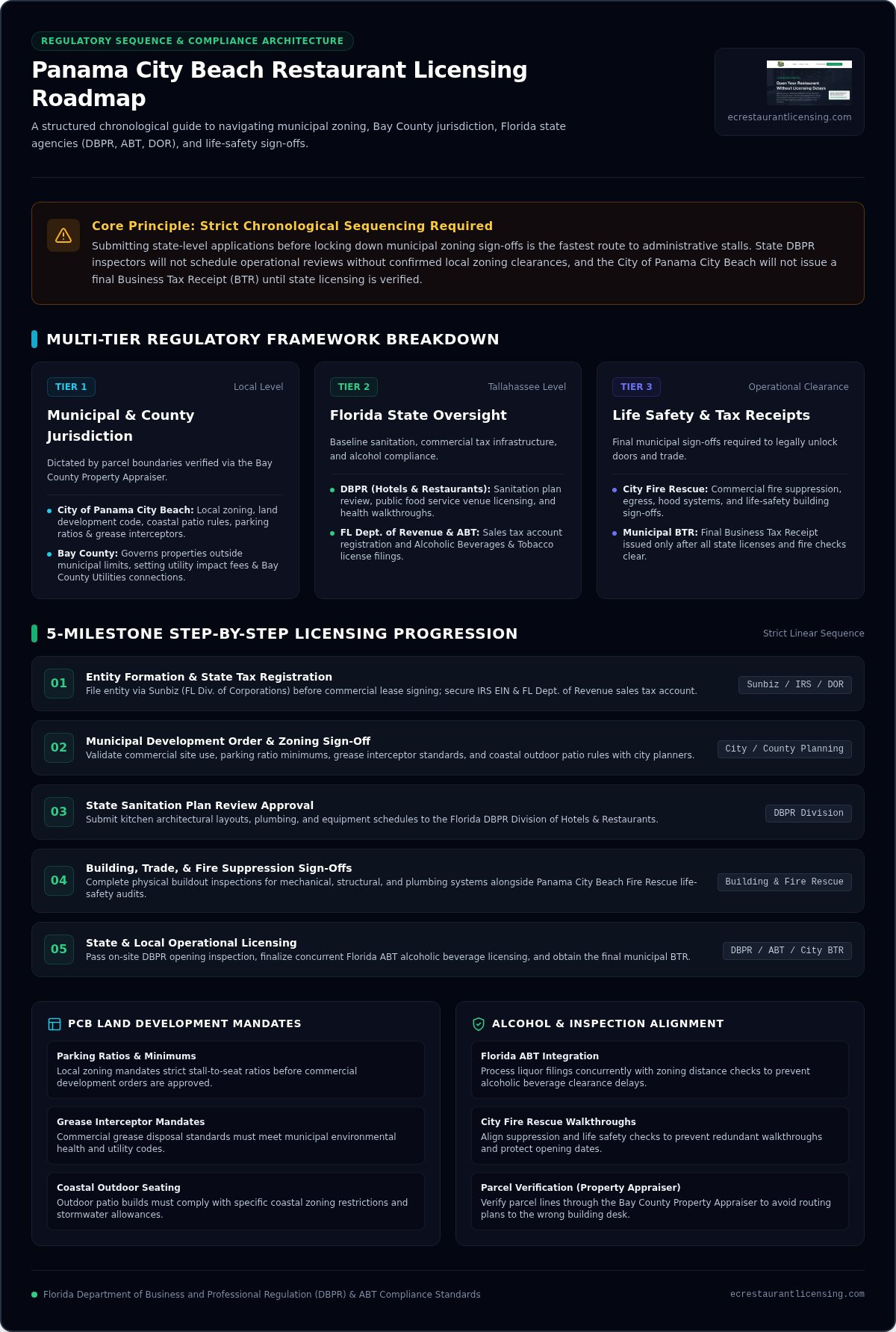
Opening a commercial dining concept along the Panhandle requires orchestrating three separate regulatory tiers. Successfully fulfilling Panama City Beach restaurant licensing requirements demands coordinating municipal offices, Bay County administrators, and state divisions in Tallahassee. Municipal websites often list independent forms, but they rarely reveal how these approvals interconnect. State inspectors won't schedule initial operational inspections without confirmed local zoning sign-offs, and the City of Panama City Beach won't issue your final Business Tax Receipt (BTR) until state licensing is verified.
Establishing a linear compliance sequence protects working capital and avoids costly project stalls:
- State Tax and Corporate Registration: Establishing legal business entities and tax accounts to enable official agency filings.
- Municipal Zoning and Plan Reviews: Validating site use, grease interceptor mandates, and parking minimums with city planners.
- State Operational Licensing: Clearing state health inspections and beverage license verifications.
- Local Operational Tax Receipts: Completing municipal pre-registration checks for final local operating authority.
Municipal vs. County Jurisdiction on the Emerald Coast
Operators frequently confuse the City of Panama City Beach with the neighbouring City of Panama City or unincorporated Bay County. Your physical parcel dictates which building department reviews your structural, mechanical, and plumbing plans. If your restaurant sits within Panama City Beach municipal limits, City Hall governs zoning allowances, stormwater compliance, and municipal BTR filings. Properties situated outside municipal boundaries fall under Bay County administration, changing your utility impact fees and connection procedures with Bay County Utilities. Verifying parcel jurisdiction through the Bay County Property Appraiser prevents submitting architectural documents to the wrong administrative desk.
The Role of Florida State Regulatory Agencies
State oversight establishes baseline sanitation, life safety, and commercial tax collection. The Florida Department of Business and Professional Regulation (DBPR), through the Division of Hotels and Restaurants, licenses public food service venues under standards aligned with U.S. food safety regulations. Before the DBPR conducts an on-site opening inspection, you must register with the Florida Department of Revenue for sales tax collection. If your concept includes beer, wine, or liquor sales, the Division of Alcoholic Beverages and Tobacco (ABT) requires concurrent processing. Filing state applications without local zoning sign-offs creates administrative deadlocks, making early jurisdictional coordination critical.
Step-by-Step Roadmap to Satisfy PCB Restaurant Licensing Requirements
Opening a restaurant along the coast requires a linear administrative plan. Skipping steps or filing out of order burns working capital while lease payments continue to accrue. Operators who follow a systematic framework move predictably from empty space to functional kitchen. Satisfying Panama City Beach restaurant licensing requirements comes down to executing filings in their mandated legal sequence rather than submitting paperwork haphazardly.
The standard operational progression requires five concrete milestones:
- Milestone 1: Entity registration with the state and federal tax assignment.
- Milestone 2: Municipal development order verification and zoning sign-off.
- Milestone 3: State sanitation plan review approval.
- Milestone 4: Building, trade, and fire suppression sign-offs.
- Milestone 5: State and local operational licensing.
Entity Formation and State Tax Registration
Form your business entity through the Florida Division of Corporations via Sunbiz before entering commercial lease negotiations. Once filed, obtain a federal Employer Identification Number (EIN) from the IRS for banking and payroll processing. Next, register with the Florida Department of Revenue to establish your sales tax account. Review our foundational Florida restaurant opening roadmap to verify your formation paperwork is properly aligned from day one.
Submitting DBPR Mandatory Plan Reviews
Newly constructed, converted, or remodeled food establishments must submit detailed documentation to Florida's Division of Hotels and Restaurants. Your plan package must include dimensional kitchen layouts, equipment schedules, finish schedules, and plumbing riser diagrams. If your layout diverges from standard sanitization rules, submit variance requests immediately rather than waiting for inspection day. Operators facing tight buildout schedules can consult our guide on navigating common Florida restaurant permit delays to manage agency review windows effectively.
Securing the Local Business Tax Receipt
Panama City Beach enforces a unique Business Tax Receipt framework. The restaurant registration year runs from March through the end of February, with fees tied to 1% of retail sales (holding a $50 minimum annual baseline). Filing late incurs an 8% monthly delinquent penalty, whereas payments made by the 10th receive a 3% early deduction. You must also secure a county-level tax receipt through the Bay County Tax Collector. If you want structured support coordinating these filings, our New Restaurant Opening Package provides end-to-end agency management. Remember that Bay County sits in DBPR District 6, requiring annual state renewals by June 1st; bookmark our guide on Florida restaurant license renewal help to prevent costly operational lapses.
Panama City Beach Restaurant Zoning Laws and Environmental Mandates
Coastal development codes create localized hurdles that catch unprepared operators off guard. Satisfying Panama City Beach restaurant licensing requirements means proving your site plan matches municipal Land Development Regulations before pulling mechanical or building permits. A location permitted for general commercial retail cannot legally function as a full-service dining room without dedicated municipal use approvals, parking assessments, and environmental infrastructure reviews.
Municipal zoning evaluates three distinct site impacts:
- Vehicular Circulation: Off-street parking stall quotas calculated against total dining square footage.
- Wastewater Protection: Grease mitigation systems engineered to prevent coastal sewer blockages.
- Shoreline Preservation: Exterior illumination and noise parameters tailored to coastal corridors.
Commercial Zoning Classifications and Use Approvals
Panama City Beach designates primary business zones as Commercial-High (CH) or Commercial-Medium (CM). While fast-casual and standard dining are permitted by right across both, concepts featuring late-night hours, drive-through lanes, or live open-air entertainment frequently require conditional use reviews. Converting an existing retail unit into a restaurant triggers a commercial change-of-use evaluation. This municipal review recalculates necessary parking ratios, ADA egress paths, and civil utility capacity before trade work begins.
Grease Trap and Municipal Utility Requirements
Grease interceptor compliance represents the most common plumbing roadblock for Panhandle restaurants. Panama City Beach enforces an Illicit Discharge and Connection Ordinance, preventing culinary fats, oils, and grease from entering the municipal storm system. Utility reviewers evaluate kitchen fixture counts to determine required exterior interceptor sizing. Your plumbing submittals must include dedicated downstream sampling ports, and operators must keep structured pump-out logs on-site for ongoing Bay County wastewater inspections.
Coastal Regulations and Outdoor Seating Permits
Beachside dining concepts face unique environmental responsibilities along Front Beach Road and coastal corridors. Properties directly fronting the water must install amber, downward-directed turtle-friendly lighting to protect nesting sea turtles. Additionally, the city's "Leave No Trace" ordinance requires personal and business furnishings removed from sandy beach areas nightly between 7:00 p.m. and 7:00 a.m. Adding patio tables or an open-air bar requires municipal sidewalk cafe permits while aligning with broader Florida alcohol license requirements to verify where perimeter service is legally allowed.
Alcohol Licensing: Integrating ABT Regulations with Panama City Beach Operations
Pouring alcohol requires reconciling state statute with municipal distance codes. When addressing Panama City Beach restaurant licensing requirements, operators must recognize that the Florida Division of Alcoholic Beverages and Tobacco (ABT) will not issue an operational beverage license without direct verification from City Hall. Securing beverage permissions demands simultaneous coordination between municipal zoning administrators and state licensing officers.
To avoid administrative gridlock, evaluate the three primary licensing pathways for regional dining venues:
- 2COP License: Authorizes on-premise consumption and package sales of beer and wine.
- 4COP Quota License: Authorizes full liquor, wine, and beer sales, but availability is restricted by county population counts.
- Special Restaurant (SFX) License: Bypasses quota availability limits for qualifying full-service dining establishments.
Florida Liquor License Categories for PCB Dining
A standard 2COP license provides an accessible pathway for cafes, bistros, and small dining concepts seeking to serve beer and wine without complex kitchen dimension minimums. In contrast, standalone bars and nightlife venues require a transferable 4COP Quota license, which trades on the open market at competitive values. Examine our strategic analysis of the real cost of a liquor license in Florida to map out accurate balance-sheet requirements for your venue.
Qualifying for a Special Food Service (SRX/SFS) License
In Bay County, high-volume dining operations can avoid purchasing a quota license on the secondary market by qualifying for a Special Restaurant License (historically known as an SRX or SFS/SFX series). Under regional rules, your physical establishment must maintain at least 2,000 square feet of continuous floor space, accommodate a minimum of 150 patrons in permanent seating, and derive at least 51% of gross operational revenue from the sale of food and non-alcoholic beverages. Commercial kitchens must stay fully operational and staffed throughout all hours of alcohol service.
Local Distance Ordinances and Municipal Zoning Sign-Off
Before the state ABT bureau processes your application, the City of Panama City Beach Development Services Department must conduct a formal zoning review and site check. The city enforces strict distance separation ordinances measuring property line boundaries between liquor establishments and protected facilities such as schools, daycares, and churches. Once municipal planners verify setback compliance, your life-safety egress maps must align with the emergency evacuation plans verified by local fire marshals. To prevent filing deadlocks across municipal and Tallahassee agencies, engage our structured Alcohol License Guidance Package to manage your entire zoning verification and state submittal pipeline.
Inspection Coordination: Achieving Final Operational Approval
Opening your doors requires clearing a synchronized gauntlet of life-safety, structural, and health evaluations. The final phase of Panama City Beach restaurant licensing requirements focuses entirely on physical verification. Even minor technical oversights, such as miscalibrated thermostatic mixing valves or missing emergency pathway lighting, can cancel a targeted launch date and force multi-week re-inspection cycles.
Coordinating final approvals involves passing three distinct municipal and state field evaluations:
- Trade and Life-Safety Sign-Offs: Securing mechanical, electrical, plumbing, and structural clearances from city inspectors.
- Fire Marshal Review: Verifying kitchen hood suppression systems and emergency egress capacity with Panama City Beach Fire Rescue.
- DBPR Health Evaluation: Proving cold-holding sanitation, hot-water thresholds, and staff hygiene readiness to the state sanitarian.
Panama City Beach Fire Rescue and Building Department Inspections
Before the state health inspector steps onto the premises, municipal authorities must sign off on life safety. Panama City Beach Fire Rescue verifies that Type I commercial kitchen hoods hold active certification tags, manual pull stations remain accessible, and suppression nozzles point directly at designated cooking surfaces. Concurrently, city building inspectors check that illuminated exit signs operate under battery backup and panic hardware functions seamlessly across exterior doors, leading to your final commercial Certificate of Occupancy.
Passing the DBPR Food Service Opening Inspection
The DBPR sanitarian conducts a thorough, ground-level assessment of your facility before issuing active operating credentials. All refrigeration units must maintain internal food holding temperatures at or below 41 degrees Fahrenheit, with particular scrutiny placed on seafood cold-storage protocols. Chemical sanitizing dish machines or high-temperature wash cycles must register required concentration levels on chemical test strips. Scheduling professional Florida restaurant mock health inspections allows your management team to discover and correct operational gaps before state officials arrive.
Securing Professional Licensing Consulting Support
Managing multi-tiered regulatory approvals across Bay County and Tallahassee agencies requires deep familiarity with local timelines. Operators planning a new concept can protect their schedule by utilizing our New Restaurant Opening Package, while existing operators benefit from our targeted Compliance & Inspection Readiness Package. Rather than dealing with redundant paperwork, contact Emerald Coast Restaurant Licensing Service to coordinate your approvals smoothly from initial planning submissions to grand opening day.
Take Control of Your Panama City Beach Restaurant Launch
Bringing a commercial culinary concept to life along the Panhandle shouldn't be derailed by administrative friction. Protecting your launch timeline comes down to executing local zoning approvals before state reviews, sizing grease management systems correctly, and synchronizing municipal fire and state health walkthroughs. Mastering Panama City Beach restaurant licensing requirements demands methodical sequencing and strategic foresight, but you don't have to tackle conflicting agency rules alone.
With decades of combined local regulatory navigation across Bay, Walton, and Okaloosa counties, Emerald Coast Restaurant Licensing Service directly bridges the gap between municipal desks and Tallahassee offices. Our structured licensing roadmaps eliminate administrative guesswork, prevent costly opening-day delays, and safeguard your operational capital from day one. Schedule a Consultation with Emerald Coast Restaurant Licensing Service to coordinate your filings and open your dining room with complete peace of mind.
Frequently Asked Questions
What licenses are legally required to open a restaurant in Panama City Beach?
You must secure a state Food Service License from the Florida DBPR, a Florida Department of Revenue sales tax certificate, a Bay County Local Business Tax Receipt, and a City of Panama City Beach Business Tax Receipt. If selling alcohol, an ABT alcoholic beverage license is required. Fulfilling all Panama City Beach restaurant licensing requirements also means obtaining local fire department and building division certificates of occupancy before public service starts.
How long does the restaurant licensing process typically take in Bay County?
The entire administrative licensing pipeline generally requires between 30 and 90 days, depending on whether the project involves new construction, space conversion, or an existing turnkey transfer. State plan reviews with the DBPR and municipal zoning clearances account for the bulk of this timeline. Submitting incomplete mechanical plans, unapproved grease trap specs, or out-of-order state applications can quickly extend project timelines by several additional weeks.
Can I transfer an existing restaurant license when buying a PCB establishment?
State food service licenses cannot be directly transferred from one business entity to another; the buyer must apply for a change of ownership license with the DBPR. However, qualifying alcohol licenses can be transferred via Florida ABT filings. Buyers must also update municipal and Bay County tax receipts. Our Restaurant Purchase & Transfer Package structures these filings to maintain operational continuity without closing dining operations.
What are the square footage and seating requirements for an SRX liquor license in PCB?
Under Bay County special act provisions, a Special Restaurant (SRX/SFS) license requires a minimum of 2,000 square feet of continuous interior space and permanent seating capacity for at least 150 patrons. In addition, the establishment must derive at least 51% of gross operational revenue from the sale of food and non-alcoholic beverages. Commercial kitchen facilities must also remain fully operational during all alcohol service hours.
Do I need both a Bay County and a Panama City Beach Business Tax Receipt?
Yes, commercial food operations located within city limits must hold both a Bay County Local Business Tax Receipt and a City of Panama City Beach Business Tax Receipt. The county verifies baseline business existence and state credentials, while the municipal receipt enforces city-level sales percentage reporting and local zoning compliance. Operating without both certificates leaves your business subject to municipal code enforcement penalties and operational stop orders.
What causes commercial kitchen plan review rejections with the Florida DBPR?
Most DBPR plan review rejections stem from omitting dedicated handwash sinks near cook lines, specifying non-commercial NSF equipment, or presenting incomplete plumbing riser diagrams. Failure to document approved water heating recovery capacities or miscalculating indirect waste lines for commercial dishwashing systems also triggers immediate revision requests. Addressing these equipment and floor-plan specifications accurately during initial submittals prevents expensive architectural revisions and opening-day delays.
How do coastal environmental regulations affect outdoor dining in Panama City Beach?
Outdoor patios must balance patron hospitality with municipal environmental mandates. Operations bordering coastal corridors must utilize turtle-safe amber lighting fixtures directed downward to protect nesting wildlife. Additionally, all beachside seating and temporary service fixtures must comply with the municipal "Leave No Trace" ordinance, which prohibits leaving items on sandy beach areas between 7:00 p.m. and 7:00 a.m. Operators must also secure city permits for sidewalk cafes.