

Panama City Beach Alcohol License Help: A 2026 Guide to Compliance and Approval
Imagine standing in your new 2,000 square foot space on Front Beach Road, ready for a grand opening, only to realize a 500 foot distance rule from a local school just stalled your 4COP-SFS application indefinitely. It is a nightmare scenario that many Bay County entrepreneurs face when they underestimate the complexity of state and municipal regulations. You already know that the difference between a 2COP and a 4COP license is more than just a few letters; it's the difference between a limited menu and a full scale bar operation. It's completely natural to feel anxious about the strict October 1 renewal deadlines or the potential for administrative fines during a high impact period.
This guide provides the professional Panama City Beach alcohol license help you need to navigate these high stakes requirements with ease. We'll provide a clear roadmap from your initial application to that successful first pour, ensuring you meet every DBPR and AB&T standard. You will learn how to qualify for specific restaurant exemptions, manage ownership transfers during a purchase, and secure the necessary zoning approvals to keep your project on track for 2026.
Key Takeaways
- Understand the dual-track approval process required by both the Florida AB&T and Panama City Beach municipal zoning departments to ensure total compliance.
- Identify whether a high-value Quota license or a 4COP-SFS restaurant exemption is the most strategic and cost-effective choice for your specific business model.
- Access expert Panama City Beach alcohol license help to manage the complexities of ownership transfers and temporary permits during a restaurant purchase.
- Follow a methodical compliance checklist to prepare your physical space for mandatory state inspections and satisfy all background check requirements for interested parties.
- Learn how professional guidance packages provide budget certainty through fixed-fee models while accelerating your path to a successful grand opening.
The Landscape of Alcohol Licensing in Panama City Beach
Establishing a bar or restaurant in the Florida Panhandle requires more than just a great menu and a prime location. It demands a precise understanding of the overlapping jurisdictions that govern alcohol sales. In this region, you're effectively serving two masters: the Florida Division of Alcoholic Beverages and Tobacco (AB&T) and the City of Panama City Beach. While most liquor licensing regulations share common roots in public safety, the specific local ordinances in Bay County introduce unique hurdles that can trip up even experienced operators. Relying on Panama City Beach alcohol license help is often the difference between a timely grand opening and a project that stalls in the administrative phase.
The financial risk of learning as you go is substantial. A single clerical error on state forms or a misunderstood zoning ordinance can result in weeks of processing delays, costing thousands in lost revenue and overhead. As we move through 2026, regulatory scrutiny remains high, particularly regarding the interaction between state permits and local municipal codes. A licensing consultant acts as a strategic navigator who bridges the gap between state regulatory demands and local municipal requirements to ensure a seamless path to operational status.
State vs. Local: Who Really Issues Your License?
The AB&T is the state level authority that issues the physical license, but they won't finalize your application without local sign off. Your first stop isn't the state office; it's Panama City Beach City Hall. You must obtain a local Business Tax Receipt (BTR) and, for hospitality venues, the Merchant BTR which assesses 1% of retail gross sales. The state requires proof that you've satisfied these local tax and registration obligations before they'll process Form ABT-6001. It's a sequential process where a failure at the local level automatically halts your state progress.
Panama City Beach Zoning and Distance Requirements
Zoning is the most common point of failure for new applicants. Panama City Beach enforces a strict 500 foot separation distance between alcohol primary establishments and schools or churches. You shouldn't sign a lease or purchase agreement without first obtaining a formal zoning verification letter from the Planning and Land Use Department. This document confirms your parcel’s wet or dry status and verifies that your intended use complies with the Land Development Code. Verifying these distance requirements early prevents the catastrophic mistake of investing in a location that can never legally serve a drop of alcohol.
Choosing the Right Alcohol License for Your PCB Business
Selecting an alcohol license requires a strategic alignment between your operational goals and Florida’s statutory requirements. In Panama City Beach, the path you choose depends heavily on your physical footprint and projected revenue streams. The Florida Division of Alcoholic Beverages and Tobacco (AB&T) classifies licenses based on very specific criteria, and selecting the wrong tier can lead to an immediate application rejection or unnecessary capital expenditure. Obtaining professional Panama City Beach alcohol license help early in the planning phase prevents these costly missteps.
Your business model dictates your licensing options. A small coffee shop serving mimosas has vastly different requirements than a high volume beachfront bar or a full service restaurant. By identifying your primary revenue driver and physical capacity upfront, you can target the most cost effective permit that supports your long term vision without overextending your startup budget.
The SRX License: The Gold Standard for Restaurants
The 4COP-SFS (formerly known as the SRX) is the most logical choice for most full service Panama City Beach eateries. Following legislative updates that went into effect recently, the threshold to qualify for this non-quota license is now 2,000 square feet of interior service space and permanent seating for at least 120 patrons. This license allows for full liquor service without the six figure price tag of a quota license, provided you maintain 51% of your gross revenue from food and non-alcoholic beverages. It's a rigorous standard that requires meticulous record keeping, but it remains the most accessible path for established dining venues.
Quota Licenses (4COP) and 2COP Permits
If your business model focuses on a bar environment where food is secondary, or if you intend to offer package sales for off-site consumption, you likely need a 4COP Quota license. These licenses are finite assets. In Bay County, market values for these licenses on the secondary market typically range between $100,000 and $350,000. For smaller operations like cafes or bistros that only require beer and wine, the 2COP permit is the most strategic move. It carries a much lower annual fee and avoids the strict square footage and seating mandates of the SFS tier.
Navigating these classifications is a complex task that impacts your bottom line from day one. Utilizing specialized alcohol license guidance ensures you select the permit that matches your specific operational needs and avoids the trap of paying for more authority than your business model requires.
Navigating Alcohol License Transfers During a Restaurant Purchase
Purchasing an existing hospitality business in Bay County is a major investment, but the deal isn't truly done until the beverage license changes hands. Many buyers assume that acquiring the physical assets automatically includes the right to serve alcohol, yet the state views the license transfer as a distinct regulatory event. Securing professional Panama City Beach alcohol license help during this transition is vital to ensure you don't inherit the previous owner's liabilities. Under the Florida Beverage Law administration statutes, the AB&T must approve the new applicant's qualifications before a permanent transfer occurs.
The state can deny a transfer for several reasons, ranging from an applicant's background to unresolved issues with the physical premises. If the previous owner has a history of selling to minors or failing to maintain records, those administrative marks may complicate your approval. A proactive approach involves a full audit of the license history to identify these risks before money changes hands at the closing table.
The most effective way to maintain cash flow during this period is the temporary permit strategy. Instead of closing your doors for weeks while the state processes your full application, you can apply for a temporary permit that allows you to continue sales immediately upon the closing of the sale. This permit typically costs 25% of the annual license fee and bridges the gap between the old owner's exit and your permanent approval. For a deeper look at this transition, see our Guide to Restaurant Ownership Changes in Florida.
Due Diligence: Auditing the Existing License
You must verify that the current license is in good standing before signing a purchase agreement. The state will deny a transfer if there are outstanding administrative fines or unresolved violations attached to the license. Even more critical is checking for tax warrants. The Florida Department of Revenue must sign off on Form ABT-6002, validating that no sales tax liens exist. If the seller owes back taxes, the state will block the transfer until the debt is cleared, potentially derailing your entire acquisition.
The Transfer Paperwork Timeline
Coordinating the transfer with the business closing requires precise timing. You need to gather background checks, fingerprints, and personal disclosures for all interested parties well in advance of the sale date. Our Restaurant Purchase & Transfer Package is designed to synchronize these state requirements with your private closing timeline. We facilitate the transition by auditing the seller's license status and managing the submission of all required DBPR documentation. This methodical approach ensures that your first day as an owner is spent serving customers rather than fighting administrative rejections.
Once you've selected your license type, the focus shifts to the physical and administrative hurdles of the application process. Securing professional Panama City Beach alcohol license help is critical at this stage to ensure your facility meets the exacting standards of the AB&T inspectors. You must prepare for a site visit where agents verify that your bar area, storage facilities, and service floors align exactly with your submitted architectural drawings. Any discrepancy between your physical space and your paperwork can trigger an immediate rejection. Beyond the building, the state scrutinizes the people behind the business. Every "Interested Party"—which includes owners, officers, and anyone with a significant financial stake—must undergo background checks and electronic fingerprinting. You also need to manage the mandatory public notice posting. This involves displaying a specific state-issued notice at your PCB location for 30 days to allow for public comment or objection. Coordinating these moving parts is a core component of our Ultimate Florida Restaurant Opening Roadmap.The Administrative Submission Process
Accuracy on the ABT-6001 form is paramount. A single missing signature or an incorrect parcel ID leads to a "Request for Information" (RFI), which can stall your application for weeks. Your floor plan must be professionally scaled and clearly label all points of sale, consumption areas, and storage. Before the AB&T issues a final approval, you must also provide concurrent sign-offs from the Division of Hotels and Restaurants or the Department of Health to certify your kitchen meets sanitation codes.Ongoing Compliance: Staying "Pour-Ready"
Compliance doesn't end once the license is on the wall. Florida’s Responsible Vendor Act offers legal safeguards, but only if you maintain a certified training curriculum for all staff members who handle alcohol. Additionally, you must stay ahead of the annual renewal cycle. For Bay County operators, licenses expire on September 30, meaning your 2026 renewal must be finalized by October 1 to avoid administrative fines or a total suspension of service. For more help with these deadlines, see our guide on Florida Restaurant License Renewal Help. To ensure your venue passes its final inspection without a hitch, consider our Compliance & Inspection Readiness Package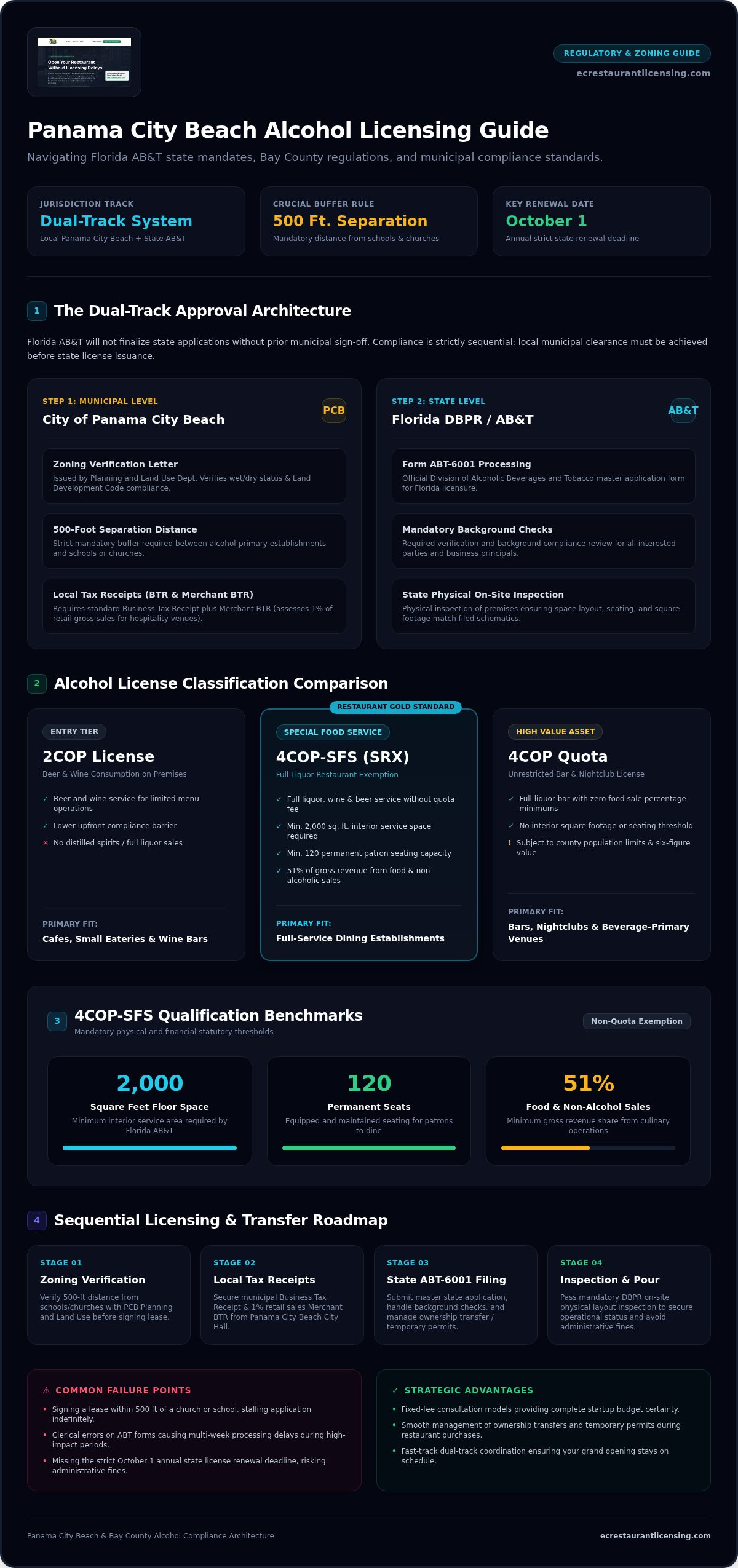
Why Professional Licensing Consultation is Essential in PCB
The return on investment for professional Panama City Beach alcohol license help is measured in weeks of recovered revenue. For a high-volume venue on the Emerald Coast, even a fourteen-day delay caused by a minor paperwork correction can result in tens of thousands of dollars in lost sales. By outsourcing the regulatory burden to a specialist, you shift from a reactive state of damage control to a proactive state of operational readiness. This strategic advantage allows you to focus on staffing and marketing while your licensing roadmap progresses behind the scenes with precision.
Budget certainty is a primary concern for new hospitality owners. Our fixed-fee consulting models eliminate the anxiety of unpredictable hourly billing, providing a clear line item for your startup costs. This predictability is essential when managing the tight margins of a new launch. Additionally, as part of our Restaurant Brokerage Services, we offer deep insight into the nuances of ownership transitions. We understand the specific expectations of Bay County inspectors and the common pitfalls, such as incorrect distance measurements or incomplete fingerprinting records, that frequently cause local applications to fail.
The Emerald Coast Alcohol License Guidance Package
This comprehensive service is designed to bridge the gap between your business goals and the DBPR’s rigid requirements. The Alcohol License Guidance Package includes full paperwork submission, the creation of a customized compliance roadmap, and thorough inspection preparation. Having a local expert who understands the regional landscape ensures that your application doesn't just meet the minimum standards but is optimized for a swift approval. We act as your liaison with the state, translating complex administrative requests into actionable steps. This local-expert feel avoids the cold, corporate detachment often found in larger firms, providing you with a steady hand during high-stakes regulatory interactions.
Securing Your Investment in Panama City Beach
Commitment to a commercial lease without a verified licensing path is a high-stakes gamble. We protect your investment by ensuring that your chosen location is truly viable for your intended license type before you sign a binding agreement. This includes verifying distance requirements from protected zones and auditing the status of your specific parcel. This level of strategic foresight moves you from a position of uncertainty toward being protected and prepared. You deserve the peace of mind that comes from knowing your grand opening isn't at the mercy of a clerical error or a missed zoning deadline. A professional consultation turns a chaotic process into a predictable, error-free journey toward your first successful pour.
Schedule your licensing consultation today
Secure Your Grand Opening with Strategic Licensing
Navigating the dual authority system between the Florida AB&T and Panama City Beach municipal zoning doesn't have to be a source of stress for your business. By selecting the correct license tier and preparing your facility for the upcoming renewal cycle, you protect your investment from costly administrative delays. Success in the Panhandle hospitality market relies on precise timing and a deep understanding of local distance requirements that govern your specific parcel.
If you're ready to move from a state of uncertainty toward being protected and prepared, our Specialized Alcohol License Guidance Package provides the steady hand you need. We offer local Bay County expertise and a fixed-fee consulting structure to ensure your journey is both predictable and error-free. Don't let a clerical error stall your grand opening when professional Panama City Beach alcohol license help is just a click away. We are committed to your long term compliance and successful launch.
Get Expert Help with Your PCB Alcohol License
Your vision for a successful venue is within reach, and we look forward to ensuring your regulatory path is clear and stable.
Frequently Asked Questions
Do I need a different license for a bar vs. a restaurant in Panama City Beach?
Yes, the classification depends on your specific business model. Restaurants typically qualify for a 4COP-SFS license if they meet size and seating requirements while maintaining 51% food sales. Bars that don't meet these food service thresholds must secure a Quota license. Choosing the wrong category can lead to significant financial loss, so it's vital to seek Panama City Beach alcohol license help to match your license to your operational goals.
How long does it take to get an alcohol license in Bay County?
Processing timelines depend on the application’s accuracy and the current DBPR workload. A new license application in Bay County generally takes between 60 and 90 days for final issuance. However, many operators utilize a temporary permit strategy to begin serving alcohol in about 30 days while the state completes its deep dive into the permanent filing. This approach prevents your business from sitting idle while waiting for administrative signatures.
Can I sell my liquor license if I close my PCB restaurant?
You can sell your license only if it is a Quota license. These are limited assets that hold significant market value in Bay County. If you hold an SFS or SRX restaurant license, it is tied to that specific location and cannot be sold as a standalone asset. If you are closing a business and need to transition a Quota license, our brokerage team can facilitate the sale to a qualified buyer.
What is the "500-foot rule" for liquor licenses in Panama City Beach?
The 500 foot rule is a local zoning ordinance that requires a minimum separation between alcohol primary venues and protected locations like schools or churches. This distance is measured precisely, and even a small discrepancy can result in a permit denial. Before signing a lease, it is essential to obtain a zoning verification letter from the city to confirm your specific parcel complies with these local land development regulations.
What happens to my alcohol license if I change my business name?
Changing your business name requires an administrative update with the DBPR to keep your license in good standing. You must file the appropriate paperwork to ensure your alcohol license matches your current Business Tax Receipt and corporate records. Neglecting this update can lead to confusion during state audits or inspections. Our team handles these administrative filings to ensure your documentation remains accurate and compliant as your brand evolves.
Do I need a separate license to serve alcohol on an outdoor patio in PCB?
A separate license isn't required, but your outdoor service area must be officially included in your licensed premises description. You must submit a floor plan that clearly delineates the patio as part of the consumption zone. Local zoning and the AB&T must approve this expansion before you begin service. Including these areas in your initial application or transfer avoids the need for a secondary modification filing later in the year.
Is a background check required for all restaurant owners in Florida?
Yes, Florida law mandates that all interested parties pass a background check and electronic fingerprinting. This includes any person or entity with a significant financial interest in the business, such as owners and corporate officers. The state performs these checks to verify that the applicants meet the statutory requirements for moral character. Gathering these background disclosures early is a key step in our Panama City Beach alcohol license help process.
Can Emerald Coast help me find a Quota license to purchase in Bay County?
We certainly can. Through our Restaurant Brokerage Services, we maintain deep insights into the secondary market for Quota licenses in the Florida Panhandle. We help clients navigate the complexities of finding a seller, negotiating the transfer, and managing the state's rigorous approval process. This service is a core component of our strategic support for hospitality investors looking to enter or expand within the Walton, Okaloosa, or Bay County markets.