

Maintaining Compliance with AB&T Florida Liquor License Regulations
What if the most significant risk to your restaurant isn't a slow weekend or rising food costs, but a surprise visit from a state inspector who finds a minor discrepancy in your seating records? For many operators in Walton, Okaloosa, and Bay counties, the pressure of maintaining an AB&T Florida liquor license feels like a constant weight. It's understandable to feel overwhelmed by the dense paperwork and the fear that a simple misunderstanding of the 2023 law changes could lead to a license suspension. Whether you're managing a 4COP-SFS establishment with its specific 120-seat requirement or holding a high-value quota license, the regulatory environment is unforgiving.
You've worked too hard to build your brand to let a compliance error derail your success. This guide will show you how to master the complexities of Florida liquor laws and protect your establishment from costly mistakes. We'll provide a methodical path toward operational readiness, covering everything from successful audit strategies to the critical differences between SRX and 4COP maintenance. By the end of this article, you'll have the clarity needed for an error-free journey and the peace of mind that comes with knowing your legal alcohol sales are fully protected.
Key Takeaways
- Understand the critical distinctions between 2COP, 4COP, and SRX licenses to ensure your venue meets Florida's specific square footage and seating mandates.
- Discover how to safeguard your AB&T Florida liquor license through proactive record-keeping and strategic monitoring of your food-to-alcohol sales ratios.
- Master the step-by-step process for successful license transfers, including the essential coordination with the Department of Revenue to avoid administrative delays.
- Identify the operational triggers that lead to surprise state audits and establish a predictable routine to keep your establishment inspection-ready.
- Learn how specialized guidance packages can move your business from a state of regulatory uncertainty to one of confident, long-term compliance.
Navigating AB&T Florida Liquor License Requirements in 2026
The Florida Division of Alcoholic Beverages and Tobacco (AB&T) is the primary regulatory body for alcohol in Florida. Securing an AB&T Florida liquor license is a significant milestone for any hospitality business, yet it represents only the beginning of a long-term regulatory commitment. In the Panhandle, where tourism and high-volume service are standard, staying ahead of these requirements isn't optional. It's the foundation of your operational stability and long-term viability.
Many operators assume that once the framed license is on the wall, the hard work is over. In reality, compliance is a living process. It requires daily attention to sales ratios, employee age verification, and invoice management. If you treat your license as a static document, you risk facing administrative fines or license suspension during a routine audit. True compliance means your records are always ready for inspection, reflecting the current state of your business at any moment.
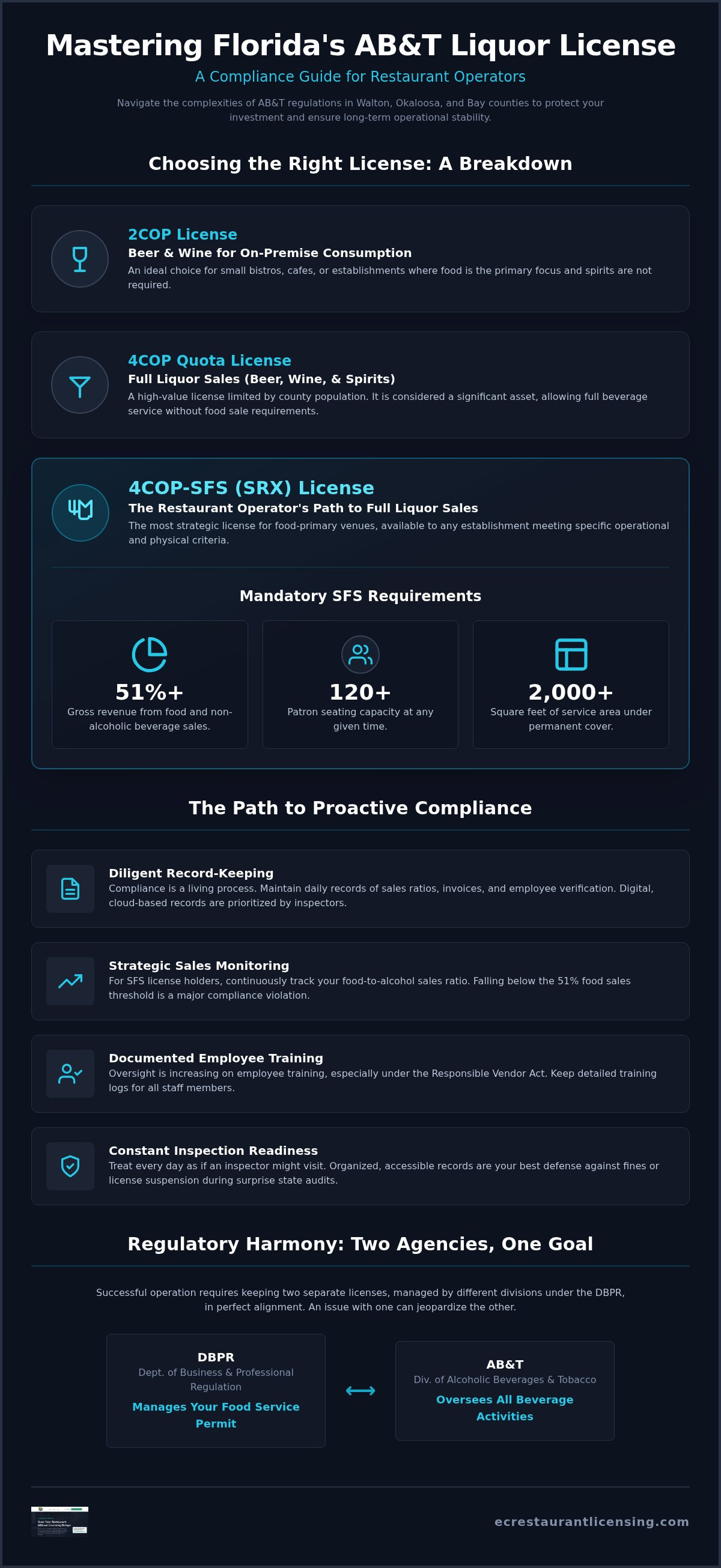
Successful operation requires managing two separate but linked agencies under the Department of Business and Professional Regulation (DBPR). While one division handles your food service permit, the AB&T oversees your beverage activities. These two licenses must remain in harmony. For instance, a restaurant's 4COP-SFS status depends on meeting food sales thresholds tracked by the AB&T but verified through the establishment's DBPR-licensed kitchen operations. If one falls out of alignment, the other is often jeopardized.
The Core Responsibilities of the AB&T
The AB&T functions as both a gatekeeper and an enforcer for the state. Their team manages the initial issuance and subsequent renewals of all alcohol permits. Beyond simple administration, they conduct field audits to ensure vendors follow the Florida Beverage Law. This includes verifying that every gallon of spirits or wine is sourced from a licensed distributor and that all state excise taxes are paid correctly. They also oversee tobacco regulations, creating a unified oversight system for age-restricted products across the state.
Why 2026 Compliance Standards are Evolving
As we move through 2026, the AB&T has transitioned toward more rigorous, data-driven oversight. Inspectors now prioritize digital record-keeping, often requesting cloud-based access to sales reports and inventory logs during an investigation. There's also a heightened focus on documented employee training, specifically under the Responsible Vendor Act. In Walton and Bay counties, local standards often involve stricter scrutiny of patio service areas and local noise ordinances. Maintaining an AB&T Florida liquor license in this environment requires a proactive stance. Adapting to these changes isn't just about avoiding trouble; it's about protecting your investment in a highly competitive market.
Choosing the Right License: 2COP, 4COP, and SRX Explained
Choosing the right AB&T Florida liquor license is one of the most critical decisions you'll make for your establishment. This choice determines your menu, your profit margins, and your long-term compliance strategy. In the Florida Panhandle, the distinction between a beer and wine license and a full spirits permit can mean the difference between a quiet cafe and a thriving destination restaurant.
The 2COP license allows for the sale of beer and wine for on-premise consumption. It's an excellent fit for small bistros or cafes where food is the primary focus and spirits aren't necessary. On the other hand, a 4COP license is the gold standard because it permits full liquor sales. However, 4COP licenses come in two distinct forms: Quota and SFS (formerly known as SRX). These permits have vastly different acquisition costs and operational requirements.
SRX License: The Restaurant Operator’s Best Friend
For many food-primary venues, the 4COP-SFS (Special Food Service) license is the most strategic path. Unlike a Quota license, which is limited by population, an SFS license is available to any establishment that meets specific physical and operational criteria. Under current official AB&T regulations, your restaurant must have at least 2,000 square feet of service area and the capacity to seat 120 patrons. The SRX license requires at least 51% of gross revenue from food sales.
Operational compliance is just as important as physical requirements. In high-volume tourist areas like Destin or Panama City Beach, it's easy for alcohol sales to creep up during peak season. You must implement a rigorous tracking system to ensure your food-to-alcohol ratio stays within legal limits. Failure to do so can trigger an audit that puts your permit at risk. Our Alcohol License Guidance Package can help you establish the reporting protocols needed to remain compliant throughout the year.
Quota vs. 2COP/4COP: Which Fits Your Business Model?
Quota licenses are finite assets tied to county population. In counties like Okaloosa, these licenses are highly sought after because they don't have the food sales or seating requirements associated with the SFS model. They are bought and sold on the open market, often for significant sums. If you're planning a bar or a lounge where food won't be the primary focus, a Quota license is your only option for full liquor.
For smaller venues, a 2COP license remains a viable and cost-effective entry point. It's much simpler to obtain and maintain than a full liquor permit. To help you weigh the financial impact of these options, you can review The Real Cost of a Liquor License in Florida to see how these fees fit into your budget. Whether you're opening a beachside cafe or a downtown lounge, matching your license to your business model is the first step toward a successful launch.
The Step-by-Step Process for AB&T License Transfers
Acquiring an existing business requires a specialized approach to regulatory handoffs. Unlike a fresh application, an ownership transfer involves moving an active AB&T Florida liquor license from one entity to another while maintaining operational continuity. This process begins the moment you sign a Purchase Agreement. You must submit a completed transfer application to the Florida Division of Alcoholic Beverages and Tobacco, signed by both the buyer and the current licensee. Without this formal submission, the state doesn't recognize your right to sell alcohol, regardless of what your private contract says.
One of the most frequent causes of delay is the Department of Revenue (DOR) clearance. The state won't approve a transfer if the previous owner has outstanding tax liabilities. You're essentially asking for a clean slate, and the DOR must verify that all sales and use taxes are paid in full before the AB&T will finalize the move. Simultaneously, new owners and any stakeholders with more than a 5% interest must undergo fingerprinting and a background check. Completing these steps early prevents the "gap" period where your doors are open, but your bar is legally required to stay closed. To manage this transition smoothly, many operators apply for a temporary permit that allows for continuous service while the permanent transfer is processed.
Due Diligence for License Buyers
Before you commit to a purchase, you must verify that the license is "clean." This means checking the public record for any pending administrative violations or unpaid fines. If a license has a history of serving minors or over-serving patrons, those marks stay with the permit even after the ownership changes. It's also vital to check for hidden tax liens that could stall your approval for months. For a deeper look at protecting your interests during this phase, consult our Navigating a Restaurant Ownership Change in Florida guide.
Coordinating with the DBPR and DOR
The transfer of your alcohol permit cannot happen in a vacuum. It must align perfectly with your food service license transfer through the DBPR. If your food permit is approved but your alcohol transfer is delayed, you'll find yourself running a "dry" restaurant during your critical opening weeks. In Walton and Okaloosa counties, processing times can vary based on seasonal volume. Coordinating these timelines requires a steady hand and a clear understanding of how each agency’s requirements overlap. Our Restaurant Purchase & Transfer Package is designed to handle these moving parts, ensuring your transition from buyer to operator is predictable and error-free.
Avoiding Common Compliance Pitfalls and AB&T Audits
The most successful operators in the Panhandle treat an audit not as a surprise event, but as a routine verification of their excellent standards. Maintaining an AB&T Florida liquor license requires a high level of administrative discipline. When an inspector walks through your doors, they aren't just looking at your seating; they're looking for a clear, documented trail of your business activities. If your records are disorganized or incomplete, a routine visit can quickly escalate into a stressful investigation involving fines or even license suspension.
Effective record-keeping is your primary defense. You're required to maintain all purchase invoices, sales reports, and employee records for a minimum of three years. These documents must be readily available for inspection at your place of business. Inspectors often act as "invisible auditors," analyzing your sales data to ensure your food-to-alcohol ratios align with your specific license type. For instance, if your spirits sales consistently outpace your kitchen revenue, the state may flag your account for a formal review. It's your responsibility to prove you're operating within the legal boundaries of your permit.
Operational changes can also trigger compliance issues if they aren't reported correctly. Many owners in Walton and Bay counties decide to add a patio or expand their bar area without updating their floor plan with the state. This constitutes "unlicensed activity" in the eyes of the AB&T. Any change to the physical footprint of where alcohol is served must be approved before you pour the first drink in the new space. Staying ahead of these requirements prevents the costly mistake of having a portion of your business shut down during peak tourist season.
Mastering the 51% Rule for SRX Licenses
If you operate under an SFS (SRX) license, your POS system is your most important compliance tool. You must categorize every item correctly to ensure your food and non-alcoholic beverage sales reach the 51% threshold. We recommend conducting a "mock audit" every quarter to identify vulnerabilities in your reporting before the state does. This proactive approach allows you to correct errors in categorization and adjust your menu strategy if your liquor sales are trending too high. For more on how to structure these internal reviews, see our guide on Florida Restaurant Mock Health Inspections.
Employee Training and Responsible Service
Your staff is your first line of defense against compliance errors. Under the Responsible Vendor Act, maintaining a file of training certificates for every employee is vital. This documentation doesn't just ensure your team knows how to spot a fake ID; it can significantly reduce your liability and potential fines if a violation occurs. In the Florida Panhandle, local training resources are available to help your team stay current on state laws. To ensure your business is fully prepared for its next inspection, consider our Compliance & Inspection Readiness Package as a strategic investment in your operational security.
Strategic Compliance: How Emerald Coast Restaurant Licensing Service Protects Your Investment
Managing an AB&T Florida liquor license shouldn't feel like a high-stakes gamble. For operators in Walton, Okaloosa, and Bay counties, the weight of state paperwork and the threat of surprise audits often create a state of constant administrative stress. We move you away from that uncertainty. Our role is to act as your seasoned navigator, providing the strategic foresight needed to bypass common pitfalls before they impact your bottom line. By positioning ourselves as your proactive partner, we ensure your journey from initial application to long-term maintenance is predictable and error-free.
Local expertise is vital in the Florida Panhandle. The regional landscape has specific hurdles that a distant, corporate consulting firm might overlook. We understand the nuances of local zoning and the specific expectations of area inspectors. This insider knowledge allows us to bridge the gap between your current confusion and a state of operational clarity. We don't just help you get a license; we help you build a compliant, sustainable business model that stands up to state scrutiny year after year.
Our Alcohol License Guidance Package
Our Alcohol License Guidance Package provides a structured roadmap designed for both new launches and established venues. We handle the heavy lifting of coordination, ensuring your paperwork submission aligns with both DBPR and AB&T requirements to avoid the administrative delays that often plague new restaurants. Our team manages the technical details of your application process, including:
- A step-by-step roadmap for initial application and annual maintenance.
- Comprehensive paperwork support to ensure every form is accurate before submission.
- Coordination of mandatory inspections and internal compliance audits to ensure your physical space matches your permit type.
- Verification of seating and square footage to meet SFS (SRX) requirements.
This specialized support allows you to focus on your menu and staff training while we handle the complexities of your AB&T Florida liquor license. We act as the steady hand that guides you through the bureaucratic maze, ensuring your doors open on time and stay open.
Securing Your Restaurant’s Future
A compliance-first culture is the best way to protect your hospitality investment. We help you establish this foundation by providing clear protocols for record-keeping and sales tracking. When it's time for an ownership transition, our Restaurant Purchase & Transfer Package ensures the handoff is seamless, protecting the market value of your asset. We've seen every possible complication and have already developed the plans to handle them, giving you the peace of mind to grow your brand with confidence. If you're ready to move toward operational clarity, consult with our licensing experts today to secure your restaurant's future.
Securing Your Operational Success in the Florida Panhandle
Maintaining an AB&T Florida liquor license is a continuous commitment that requires both strategic planning and daily attention to detail. We've explored how choosing the right permit type, such as the 4COP-SFS, and mastering the 51% food sales rule are essential for long-term stability. You now understand that successful compliance isn't just about passing an initial inspection; it's about building a culture of readiness that protects your business from surprise audits and administrative delays.
As a local Panhandle expert, we provide the steady hand you need to navigate these high-stakes regulations in Walton, Okaloosa, and Bay counties. Our fixed-fee consulting packages and comprehensive compliance auditing move you away from uncertainty and toward operational clarity. Don't let the complexity of state paperwork stand in the way of your restaurant's growth or your peace of mind.
Secure your establishment with our Alcohol License Guidance Package and gain the confidence that comes with professional oversight. Your successful journey as a Florida operator is well within reach, and we're here to ensure it remains a predictable, error-free experience.
Frequently Asked Questions
What is the difference between an SRX and a 4COP liquor license in Florida?
An SRX license, now officially called a 4COP-SFS, is a non-quota permit for restaurants that meet specific size and sales thresholds. It requires at least 2,000 square feet of service area and capacity for 120 patrons. Conversely, a standard 4COP quota license is a limited asset tied to county population. While the SFS license requires 51% of revenue from food, a quota license allows for bar-primary operations without these strict seating mandates.
How long does it typically take to transfer a Florida liquor license?
The timeline for an AB&T Florida liquor license transfer typically spans 30 to 60 days. This period allows the state to conduct background checks and verify Department of Revenue clearance for the previous owner. In Walton and Okaloosa counties, processing times can fluctuate based on seasonal application volume. Completing your fingerprinting and tax verifications early in the process is the most effective way to ensure your transfer stays on schedule.
Can I serve alcohol while my AB&T license transfer is pending?
You can maintain alcohol service during a pending transfer by securing a temporary permit from the AB&T. This permit bridges the gap between the purchase of the business and the final issuance of the permanent license. It's a critical step for Panhandle operators who cannot afford a service interruption. Our Restaurant Purchase & Transfer Package specifically coordinates this timing to ensure your bar remains operational throughout the entire administrative transition.
What happens if my restaurant fails to meet the 51% food sales requirement?
Failing to meet the 51% food and non-alcoholic beverage sales requirement can lead to administrative fines or the revocation of your 4COP-SFS license. The AB&T monitors these ratios through audits of your sales records. If you fall below the threshold, you may lose your spirits permit entirely. Proactive monitoring of your POS categorization is vital to ensure your kitchen revenue consistently supports your alcohol service legalities and protects your investment.
Do I need a separate license for beer and wine vs. full liquor in Florida?
Yes, Florida utilizes a tiered system that separates beer and wine service from full liquor sales. A 2COP license is designed for small bistros or cafes that only intend to serve beer and wine. If you plan to serve spirits, you must obtain a 4COP-SFS or a quota license. Transitioning from a beer and wine permit to a full liquor license requires a completely new application and verification of seating or quota availability.
How much does an AB&T Florida liquor license cost in 2026?
In 2026, the annual fee for a 2COP license ranges from $168 to $392, while a 4COP-SFS license costs $1,820 annually. Standard 4COP quota license fees range from $624 to $1,820 depending on the county population. If you win a new license in the annual quota drawing, you'll face a one-time issuance fee of $10,750. These state fees are separate from any consulting or brokerage costs associated with acquiring your permit.
What records am I required to keep for an AB&T compliance audit?
You are required to maintain a comprehensive file of purchase invoices, categorized sales reports, and employee training certificates for at least three years. During an AB&T Florida liquor license compliance audit, inspectors will verify that all alcohol was purchased from licensed distributors and that your food-to-alcohol sales ratios are accurate. Keeping these records organized and accessible at your establishment is the best way to demonstrate operational readiness and avoid costly administrative penalties.
How often do I need to renew my Florida restaurant liquor license?
Florida liquor licenses must be renewed every year. The specific deadline depends on whether your county falls into the September or March renewal series. Missing a renewal deadline can result in late fees or a temporary loss of your right to sell alcohol. We help our clients track these dates as part of our Alcohol License Guidance Package, ensuring your establishment remains in good standing with the state without any service gaps.