

Fort Walton Beach Restaurant Broker: Buyer & Seller Guide
What if the right restaurant deal runs into trouble because transaction planning and licensing preparation weren’t coordinated? If you’re buying or selling in Fort Walton Beach, you’ll want a clear picture of the restaurant’s value, its readiness for a sale, and how ownership-transfer paperwork may affect the process. A Fort Walton Beach restaurant broker can provide valuation, marketing, and transaction support, but brokerage and licensing assistance are separate services.
This guide explains how to assess a broker’s local experience and service fit, what to prepare before a restaurant transaction, and what to expect during the buying or selling process. It also covers how to plan licensing work alongside a deal without treating it as part of brokerage. Separate licensing guidance can help with ownership transfers, paperwork, and inspection preparation. Confirm current requirements with the appropriate agencies. With clear roles and a practical plan, you can approach the transaction with fewer avoidable surprises.
Key Takeaways
- Choose a Fort Walton Beach restaurant broker whose local experience and services fit your goals as a buyer or seller.
- Assess a restaurant in context: its concept, location, lease terms, records, and your transaction objectives all matter.
- Compare brokers on relevant experience, service scope, communication, and clear written engagement terms.
- Plan for a staged process, from setting goals and gathering information to discussions and closing coordination.
- Plan licensing readiness alongside the transaction, while keeping brokerage support distinct from separate licensing guidance.
What a Fort Walton Beach Restaurant Broker Does for Buyers and Sellers
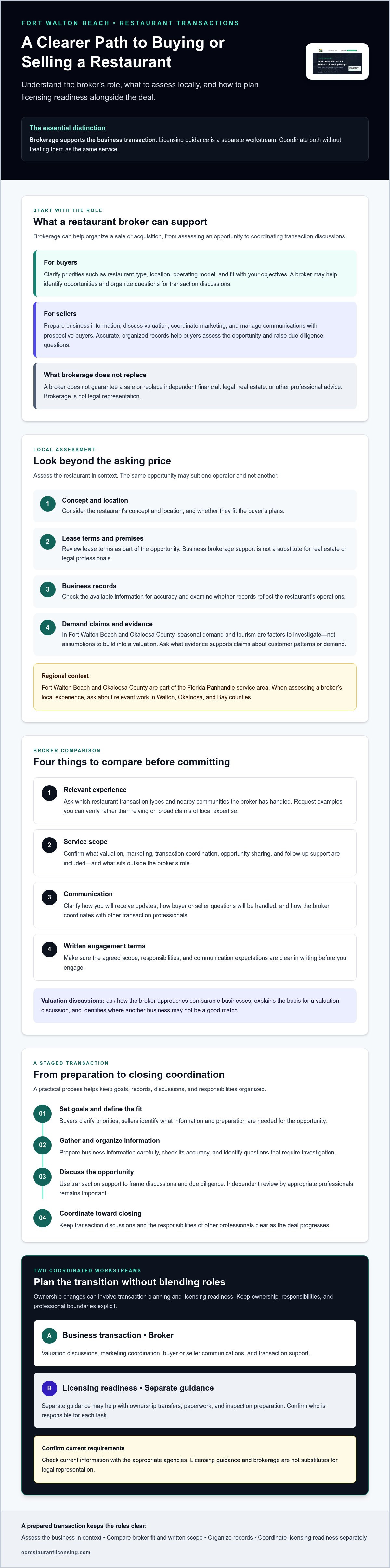
A restaurant broker helps buyers and sellers organize a business sale or acquisition, from assessing an opportunity to coordinating transaction discussions. Buyers may need help comparing opportunities and identifying questions to investigate. Sellers may need to prepare business information, discuss valuation, and market the opportunity while managing buyer inquiries. For a neutral primer on what a business broker does, see the general overview of the role.
A restaurant broker supports the business transaction through valuation, marketing, and transaction coordination, but doesn’t guarantee a sale or replace specialized professional advice. Brokerage focuses on the business transaction; licensing consulting is a separate service that can provide guidance and administrative support for licensing readiness. Neither service is legal representation. A restaurant sale may also involve a lease or premises, but brokerage support for the business is not a substitute for real estate or legal professionals.
How a restaurant broker supports a buyer
A buyer can use brokerage support to clarify priorities, such as restaurant type, location, operating model, and fit with their objectives. The broker may help identify available opportunities and organize questions for transaction discussions. Valuation and transaction support can help frame due diligence, but don’t replace independent review by appropriate financial, legal, or other professionals. Before engaging a Fort Walton Beach restaurant broker, confirm the agreed scope, how opportunities will be shared, who will handle follow-up, and how you’ll receive updates.
How a restaurant broker supports a seller
For sellers, brokerage support can help structure business preparation, valuation discussions, marketing coordination, and communications with prospective buyers. Organize information carefully and check it for accuracy. Clear records help buyers assess the opportunity and identify questions for due diligence. Ask how the broker will present the business, manage inquiries, and decide what information to share and when. For additional context on planning a transition, read this Florida restaurant ownership-change guide.
Consider licensing readiness alongside transaction planning, especially when ownership will change, but treat it as a separate workstream. A broker can support the business transaction, while distinct licensing packages provide guidance on ownership transfers, paperwork, or inspection preparation. Confirm which provider is responsible for each task, and seek qualified professional advice for matters outside the broker’s agreed scope. Clear roles help buyers and sellers prepare without confusing deal support with licensing or legal services.
What Fort Walton Beach Buyers and Sellers Should Assess Locally
An asking price tells only part of the story. In Fort Walton Beach and elsewhere in Okaloosa County, assess the restaurant’s concept and location, lease terms, business records, and fit with the buyer’s plans. A restaurant that suits one operator may not suit another, even if both are considering the same opportunity.
Fort Walton Beach and Okaloosa County are part of the Florida Panhandle service area; seasonal demand and tourism are factors to investigate, not assumptions to build into a valuation. Ask what evidence supports claims about customer patterns or demand, and check whether the available records reflect the restaurant’s operations. The Florida Department of Business and Professional Regulation provides information on Florida broker licensing requirements. Review current agency information and confirm how it applies to the professional you’re considering.
Questions to ask about a broker’s local experience
Ask which restaurant transaction types and nearby communities the broker has handled, including work in Walton, Okaloosa, and Bay counties. Request relevant examples you can verify instead of relying on broad claims of local expertise. Ask how the broker approaches comparable businesses and explains the basis for a valuation discussion. A useful comparison should also explain where another business may not be a good match for yours. Clarify how you’ll receive updates, how buyer or seller questions will be handled, and how the broker coordinates with other transaction professionals.
Local due diligence beyond the asking price
Buyers should examine the obligations and records behind an opportunity, not just the asking price. Group questions by topic and track which items still need independent review:
- Lease: Review the terms, responsibilities, and any transfer or approval considerations with the appropriate professionals.
- Business records: Compare financial and operating information, and ask for clarification when details are incomplete or inconsistent.
- Equipment and operations: Assess equipment condition and review operating information relevant to the restaurant’s concept.
- Licenses and permits: Identify what exists and separately confirm whether any items need review or action as part of the proposed ownership transition.
Sellers can use this Florida restaurant sale document checklist to organize preparation. A Fort Walton Beach restaurant broker familiar with the area should be able to explain how local context informs the transaction without presenting unverified market assumptions as fact. For a starting point on regional brokerage and separate licensing support, see Florida Panhandle restaurant transaction support.
How to Compare Fort Walton Beach Restaurant Brokers Before You Commit
Before signing an engagement, compare what each broker will do, how they’ll communicate, and what the written terms say. A Fort Walton Beach restaurant broker should be able to describe the proposed scope in practical terms, not just outline a general process. Use the questions below to identify what needs clarification.
| What to compare | Questions to ask |
|---|---|
| Relevant experience | What types of restaurant transactions and Florida Panhandle communities have you worked with? How do you approach valuation for this business? |
| Service scope | Does the engagement include valuation, marketing, buyer screening, transaction support, or only some of these tasks? What falls outside the scope? |
| Communication | Who will be my main contact? How will progress, buyer inquiries, and next steps be shared? |
| Compensation and terms | How are compensation, expenses, representation, confidentiality, and any potential conflicts described in the written agreement? |
Broker experience, scope, and communication
Ask for a clear outline of the work proposed for your transaction. For a seller, that may include valuation discussions and marketing coordination. For a buyer, it may include reviewing opportunities and organizing transaction questions. Confirm who handles each task and how updates will be shared. Read the broker agreement carefully, including commission terms and the conditions that govern the relationship. If anything is unclear, ask for an explanation before signing.
Brokerage versus licensing and legal support
Brokerage support addresses the business transaction. Licensing requirements are a separate workstream, and current requirements should be confirmed with the appropriate agencies or qualified advisers. Ask who will answer licensing questions, whether that person provides consulting or administrative guidance, and what the support covers. Emerald Coast Restaurant Licensing Service offers separate licensing consulting packages, but does not provide legal representation. Keep the roles distinct so you know where to direct each question.
A professional Fort Walton Beach restaurant broker provides brokerage services that include valuation, marketing, and transaction support. If you’re weighing your options, discuss your transaction needs with prospective brokers and clarify which services fit your situation. For another set of selection questions, consult a trusted Florida restaurant broker selection guide.
What to Expect During a Restaurant Sale or Purchase in the Florida Panhandle
A restaurant transaction usually involves several connected stages, though the order and details can vary with the business, the parties’ agreement, and professional advice. A Fort Walton Beach restaurant broker may support valuation, marketing, or transaction coordination. Licensing work is separate, so identify that track early instead of assuming it will be resolved as part of brokerage.
- Set goals and boundaries. Sellers should clarify their preferred transition and how information about the opportunity may be shared. Buyers should define acquisition priorities, including the type of operation and location they’re seeking. Agree on communication expectations before moving forward.
- Gather and review information. Sellers can organize accurate business and operating records for review. Buyers can prepare questions about operations, lease terms, available records, and what they need to assess the opportunity. Each party should consult appropriate legal, accounting, and other independent professionals as needed.
- Discuss valuation and marketing or search. For a sale, brokerage support may include valuation discussions and marketing coordination. For a purchase, the process may involve identifying opportunities that fit the buyer’s criteria. The approach depends on the engagement and information available.
- Work through offers and due diligence. The parties discuss proposed terms and clarify outstanding questions. Keep a record of open items and direct specialized questions to the appropriate professional. A broker can assist with transaction coordination, but shouldn’t replace independent professional advice.
- Coordinate closing tasks and transition planning. As the parties work toward closing, confirm who is responsible for each document, decision, and follow-up item. Ownership changes may also raise licensing questions that require separate review. Verify current agency requirements for the specific transaction rather than relying on assumptions about existing licenses or permits.
Coordinate transaction milestones with licensing readiness
Identify licensing questions early and confirm the responsible agency and current requirements for the particular case. Paperwork preparation and inspection readiness may need to be planned alongside transaction milestones, but don’t assume approval or timing. Record dependencies, responsible contacts, and follow-up tasks so brokerage, licensing consultants, agency contacts, and other advisers understand where their work connects. For broader transition-planning context, see the Florida ownership-change buying guide.
For a transaction in Fort Walton Beach or the surrounding Florida Panhandle, discuss your brokerage needs and licensing questions with Emerald Coast’s restaurant team and confirm which support applies to your situation.
Work With a Fort Walton Beach Restaurant Broker Who Understands the Full Transition
A restaurant transaction can involve two related but distinct workstreams: acquiring or selling the business, and preparing for licensing matters connected with a change or opening. A Fort Walton Beach restaurant broker can support buyers and sellers with valuation, marketing, and transaction assistance. Separate licensing packages may provide guidance for new openings, ownership transfers, compliance readiness, or alcohol-license matters.
Considering both workstreams early can help you identify questions and responsibilities before they become last-minute surprises. It doesn’t guarantee faster approval, a completed transaction, or a particular outcome. Service scope depends on the engagement, agency requirements depend on the situation, and deal outcomes depend on the parties and transaction details.
When brokerage and licensing consulting may work together
Brokerage focuses on the business transaction. Licensing consulting is separate and may help with licensing roadmaps, paperwork support, or inspection preparation, depending on the package and circumstances. These services aren’t legal representation, and they don’t replace agency guidance or other professional advice. Before proceeding, confirm which provider handles each task, what the written scope includes, how responsibilities connect, and which engagement terms apply. Clear boundaries make it easier to coordinate without assuming one service covers the other.
Start a focused conversation about your restaurant transaction
Whether you’re exploring a purchase, preparing to sell, or planning an ownership transition, bring a few practical details to the conversation: the restaurant’s location, its business type, your stage in the process, and the questions that need attention first. This can help clarify whether brokerage support, licensing consulting, or both may be relevant. Confirm current service availability and coverage for your specific transaction before moving forward.
Emerald Coast Restaurant Brokers and Emerald Coast Restaurant Licensing Service support restaurant buyers and sellers in the Florida Panhandle through separate brokerage and licensing offerings. Share your transaction needs and ask which service scope fits your situation. Contact Emerald Coast through the homepage to start the conversation.
Plan Your Restaurant Transaction With Clear Next Steps
A well-planned restaurant transaction starts with a broker whose experience and services fit your goals. A Fort Walton Beach restaurant broker can support valuation, marketing, and transaction coordination, while due diligence and independent professional advice help you evaluate the opportunity. Keep licensing work distinct, but identify related questions early so responsibilities and next steps are clear.
Emerald Coast restaurant brokerage and licensing support serve buyers and sellers across Okaloosa, Walton, and Bay counties. Separate consulting packages can assist with licensing roadmaps, ownership transfers, and inspection preparation. The right scope depends on the transaction, so confirm which services apply to your circumstances before proceeding.
Whether you’re preparing to sell or considering a purchase, bring your location, transaction stage, and immediate questions to the conversation. Discuss your Fort Walton Beach restaurant transaction with Emerald Coast and clarify which brokerage or consulting support may be relevant. With a clear plan and the right professional roles in place, you can take your next step with confidence.
Frequently Asked Questions
What does a restaurant broker do in Fort Walton Beach?
A Fort Walton Beach restaurant broker can support a business sale or acquisition through valuation, marketing, and transaction coordination. The specific tasks depend on the written engagement, so ask what’s included and who handles each responsibility. Brokerage isn’t legal representation, and it doesn’t determine licensing decisions. Before signing, confirm the broker’s restaurant transaction experience and service coverage for Fort Walton Beach and the surrounding area.
How do I choose a restaurant broker in Okaloosa County?
Compare brokers on relevant transaction experience, service scope, communication, confidentiality practices, and written engagement terms. Ask how they approach valuation and marketing, manage buyer or seller inquiries, and direct licensing questions to a separate consultant. Request clear explanations rather than relying on unverified sales claims. For a restaurant in Okaloosa County, choose a broker who can describe a process suited to your transaction and clarify responsibilities before you commit.
Can a restaurant broker help with a Florida license transfer?
A restaurant broker may coordinate transaction planning, but brokerage isn’t agency approval or legal representation. Requirements depend on the license and circumstances, so confirm current instructions with the relevant Florida agency. Ask what administrative guidance is included in any separate consulting engagement. Emerald Coast offers licensing consulting for ownership transitions; confirm the scope for your case and who is responsible for each step rather than assuming an existing license will carry over.
How much does a restaurant broker charge in Fort Walton Beach?
Restaurant brokerage compensation depends on the broker’s written engagement and the transaction. Emerald Coast describes its brokerage fees as commission-based, but don’t assume a rate or payment arrangement. Ask how compensation is calculated, when it becomes payable, which services it covers, and whether other terms apply. Review the agreement carefully, and consult an independent professional if you need help assessing its legal or financial implications.
What should I review before buying a restaurant in Fort Walton Beach?
Review available financial and operating records, lease obligations, equipment condition, business commitments, and relevant licenses or permits. Separate confirmed information from items that need independent verification. Ask the broker to clarify the transaction process and direct specialized questions to the appropriate professionals. Don’t assume a seller’s current licensing status automatically applies after an ownership change. Confirm current requirements for the specific restaurant and proposed transition.
Does a restaurant broker also provide legal or licensing services?
Brokerage, licensing consulting, and legal representation are distinct services. Emerald Coast Restaurant Licensing Service offers licensing guidance and administrative support alongside restaurant brokerage, but doesn’t provide legal representation. Ask which tasks are covered by the brokerage engagement, which may require a separate licensing package, and which need an attorney or other qualified professional. Confirm current agency requirements directly before making plans based on an existing license’s status.
Should I hire a broker before listing my restaurant for sale?
Speaking with a broker before listing can help clarify valuation, marketing, preparation, and the transaction process. Organize accurate business records and be ready to explain your goals and transition preferences. Ask about confidentiality, representation, compensation, and responsibilities in writing. A conversation can help identify appropriate next steps, but it doesn’t guarantee a sale or a particular outcome. Confirm that the broker’s proposed services fit your needs before signing an engagement.