
Florida SRX License Requirements: The 2026 Guide to Special Restaurant Liquor Licensing
Why would you pay six figures for a Florida quota license when the key to a full bar might already be hidden in your restaurant's floor plan? For many owners, the high cost of entry feels like a barrier that can't be crossed without massive capital. You've likely felt the frustration of trying to decode the Florida liquor license application process while worrying that a single square-footage error could derail your entire launch. It's a high-stakes environment where the difference between a successful opening and a costly delay often comes down to precise administrative preparation.
Emerald Coast Restaurant Licensing Service is here to provide the steady hand and specialized guidance you need to secure a 4COP-SFS license affordably. This 2026 guide simplifies the complex seating, square footage, and revenue rules that define modern compliance. You'll learn how to meet the 2,500 square foot rule and the 150-seat capacity requirement without the guesswork. We'll also explore the 51% food revenue rule to ensure your business passes its initial AB&T inspection and maintains long-term operational readiness. By the end of this article, you'll have a predictable path to a full liquor license that protects your investment and your peace of mind.
Key Takeaways
- Understand why the 4COP-SFS license is the most cost-effective way to serve full liquor without the high price tag of a quota license.
- Learn the specific 2026 seating and square footage requirements your floor plan must meet to pass the initial state inspection.
- Master the "51% Rule" to ensure your food sales consistently outweigh alcohol revenue, protecting your license from future audits.
- Navigate the Florida liquor license application process with a clear roadmap for zoning approvals and DBPR ABT-6001 submissions.
- Identify common pitfalls, such as unauthorized floor plan changes, that can lead to immediate license suspension.
What is a Florida SRX (SFS) License?
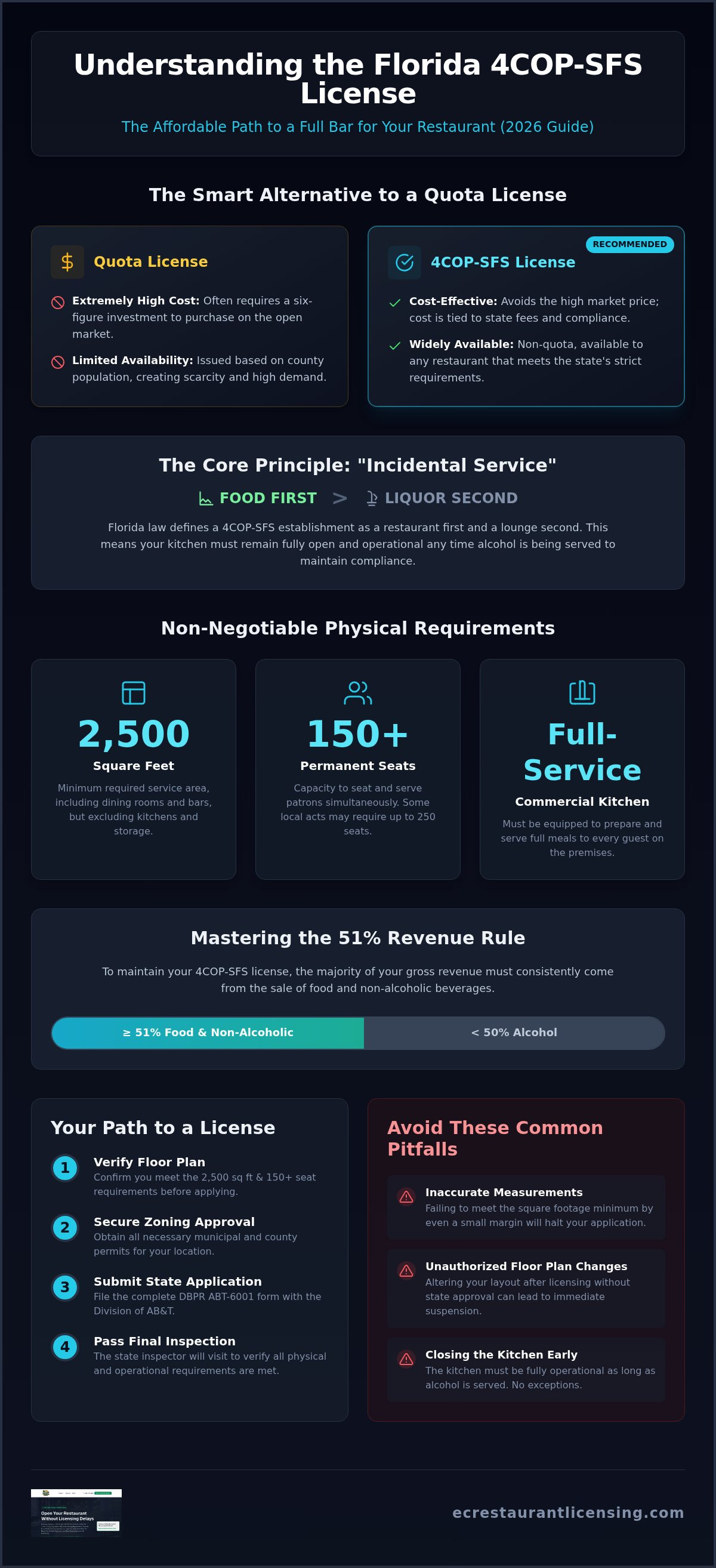
Securing the right to serve spirits shouldn't require a six-figure investment or years on a waiting list. In Florida, the SRX license serves as a specialized gateway for restaurants that want to offer a full bar without the burden of a quota permit. An SRX license is a non-transferable permit for restaurants meeting specific size and revenue criteria. While many owners start the Florida liquor license application process assuming they must purchase a limited quota license from the open market, the SRX designation offers a streamlined, more affordable path for true food-service establishments.
The Florida Division of Alcoholic Beverages and Tobacco (ABT) oversees this permit to ensure that liquor service remains secondary to the dining experience. Unlike quota licenses, which are limited by county population and can cost hundreds of thousands of dollars, these permits are non-quota. This means they're available to any operator who can prove their physical space and sales mix meet state standards. It's a compliance-heavy route, but it's the most reliable way to protect your margins and your peace of mind.
SRX vs. SFS: Understanding the Terminology
Many online resources still rely on outdated terminology, referring exclusively to SRX permits. However, if you're beginning the Florida liquor license application process in 2026, you'll encounter the 4COP-SFS designation. The state transitioned to the Special Food Service (SFS) label to more accurately reflect the nature of these establishments. While the acronym has changed, the underlying requirements haven't softened. Your actual business license will bear the SFS code, but don't be surprised when industry veterans and older state documents still use the SRX shorthand.
Incidental Service: The Legal Foundation
The core philosophy of this license is that alcohol service must remain incidental to food service. This legal foundation is what allows the state to issue these permits without the population-based limits of a quota license. Florida law draws a sharp line between a bar and a restaurant. In the eyes of regulators, your business is a dining room first and a lounge second. This means your kitchen must stay open and fully operational as long as alcohol is being served. If an inspector finds the kitchen closed while drinks are flowing, your compliance standing is immediately at risk. Every stool and every square foot of your layout must support the dining mission to satisfy state inspectors.
Physical Requirements: Seating and Square Footage
Physical space isn't just about aesthetics; it's the primary factor determining your eligibility for a 4COP-SFS permit. For 2026, the standard requirement remains 2,500 square feet of service area. This is a non-negotiable metric. If your blueprints fall short by even a few inches, the Florida liquor license application process will stall before you even reach the inspection phase. Beyond the footprint, your establishment must function as a full-service restaurant. This means maintaining a kitchen equipped with commercial-grade appliances, such as hood systems and grease traps, capable of serving full meals to every guest in the building. Under Florida Statutes Chapter 561, the state enforces these physical standards to prevent establishments from circumventing quota license laws.
The 2,500 Square Foot Rule
The definition of "service area" is where many operators stumble. It generally includes areas accessible to the public, such as the dining room and bar seating. It typically excludes the kitchen, walk-in coolers, and storage closets. If you're counting on an outdoor patio to meet the 2,500 square foot threshold, ensure it's a permanent, contiguous part of the licensed premises. Inspectors don't just look at the lease; they measure the usable space where guests are served. Identifying these boundaries early is a core part of our Compliance & Inspection Readiness Package, which helps you verify your measurements before the state arrives. We pay special attention to regions like Walton County, where local acts may modify these standard dimensions.
Seating Capacity and Fire Marshall Limits
While the state baseline is often 150 seats, local special acts in the Florida Panhandle can push this requirement as high as 250 seats in certain districts. You must maintain the capacity to seat and serve the required number of patrons simultaneously. This doesn't mean having "room" for 150 people; it means having 150 permanent seats and tables ready for use at all times. These numbers must also align with your local fire marshall's occupancy limits. If the fire marshall caps your room at 140 people but the AB&T requires 150 for an SFS license, you have a conflict that must be resolved through architectural changes or a different license type. We often see owners try to use temporary folding chairs to hit their count during an inspection, but this is a guaranteed way to fail and delay your opening.
The 51% Rule: Navigating Food and Alcohol Revenue
Securing your license is only the first hurdle. Maintaining it requires a disciplined approach to revenue management. At least 51% of gross revenue must derive from the sale of food and non-alcoholic drinks to satisfy the requirements of the Florida Administrative Code. This ratio is the bedrock of the SFS permit. If your alcohol sales consistently eclipse your food revenue, the state views your establishment as a bar rather than a restaurant, which can lead to immediate administrative action. For many operators, this is the most stressful part of the Florida liquor license application process because it requires ongoing vigilance rather than a one-time approval.
Categorizing sales correctly is essential for compliance. When you offer bundled items like brunch packages or "all-you-can-eat" specials that include a drink, you must have a clear accounting method to separate the food value from the alcohol. Happy hour promotions also require careful tracking. If you discount food significantly while maintaining high margins on spirits, you may inadvertently skew your ratios toward the danger zone. You can find more specific guidance on these operational nuances in the DBPR Alcoholic Beverage & Tobacco FAQs, which clarify how the state interprets these revenue streams.
Tracking Your Ratios Monthly
Don't wait for a state auditor to tell you that your ratios are off. Successful operators review their sales data every month. This starts with proper POS categorization. You should separate food, non-alcoholic beverages, beer, wine, and spirits into distinct reporting buckets. It's also vital to handle service charges and gratuities correctly. Generally, automatic gratuities or service charges added to a bill aren't counted as gross revenue for the 51% calculation, but they must be documented clearly to avoid inflating your total sales figures during a review.
What Happens During a DBPR Audit?
A DBPR audit is a methodical verification of your business's operational reality. Auditors typically conduct a 3-year lookback of your financial records to ensure consistent compliance. They'll request specific documents, including daily sales reports, purchase invoices from distributors, and state tax returns. The timeline for a standard compliance inspection can vary, but it usually begins with a request for records followed by an on-site visit to verify that your kitchen is functional and your menu matches your sales data. To prepare for these high-stakes moments, many owners utilize our Florida Restaurant Mock Health Inspections to identify red flags before a state official finds them. This proactive step ensures that when the real audit occurs, your documentation is organized and your staff is prepared to answer questions confidently.
The Application and Inspection Path in 2026
Moving from planning to execution requires a precise sequence of actions. The Florida liquor license application process isn't a single event but a multi-stage verification journey. It begins long before you touch a state form. You must first secure local municipal sign-offs to ensure your location is legally permitted to serve alcohol. Once zoning is cleared, you move to the formal submission of the DBPR ABT-6001 application packet. This document is comprehensive, requiring background checks, fingerprints, and proof of your right to occupy the premises. Mistakes during this initial filing can lead to months of administrative delays and lost revenue.
Zoning and Local Sign-Offs
Local regulations often present the steepest hurdles for new operators. In the Florida Panhandle, counties like Walton, Okaloosa, and Bay frequently enforce specific distance requirements from schools or churches. You don't want to sign a long-term lease only to discover you're fifty feet too close to a protected zone. Simultaneously, you must coordinate with the Department of Health; their approval is a prerequisite for the liquor inspection. Coordinating these local approvals is a vital part of the Florida liquor license application process that many owners overlook. Managing these moving parts is a core element of The Ultimate Florida Restaurant Opening Roadmap, which ensures you don't miss a local deadline.
The AB&T Physical Inspection
The physical inspection is the moment of truth. An AB&T agent will visit your site to verify that the operational reality matches your application. They don't just glance at the room; they count every seat and measure table dimensions to ensure they meet the 4COP-SFS standards. They'll also verify that your kitchen equipment is operational and matches the commercial-grade requirements for a full-service establishment. A critical trap is the "Day One" menu requirement. You must be ready to serve the full menu described in your application the moment the inspector walks in. If your fryers aren't hot or your prep tables are empty, the inspector will likely deny the issuance and require a follow-up visit.
After a successful inspection, you'll receive your temporary permit, followed by the final license issuance. However, the work doesn't end there. You enter a post-licensing compliance window where your revenue ratios and operational standards remain under state scrutiny. To navigate this final stretch without error, consider our New Restaurant Opening Package to manage every detail from zoning to the final sign-off.
Avoiding Common Pitfalls with Expert Guidance
Obtaining your permit is a milestone, but the Florida liquor license application process doesn't truly end on opening day. A common mistake is the "set it and forget it" mentality, where owners assume that initial approval guarantees long-term compliance. In reality, an SFS license is a commitment to a specific operational model that the state can revoke if standards slip. One of the most dangerous traps is unauthorized remodeling. Because your license is tied to the specific floor plan and seating count verified during your initial inspection, moving a wall or removing tables can void your permit. Any change to your physical footprint requires a formal notification and often a re-inspection to ensure you still meet the 2,500 square foot service area requirement.
You should also understand the difference between a liquor license broker and a licensing consultant. Brokers typically operate in the secondary market, helping businesses buy or sell expensive quota licenses. A licensing consultant, like Emerald Coast Restaurant Licensing Service, focuses on the administrative and regulatory path of the SFS permit. We don't just find a license; we build the compliance framework that allows you to operate without the high cost of a quota purchase. This proactive support is what prevents the administrative errors that lead to license suspension or costly legal fees.
Maintaining Compliance Year-Round
Proactive monitoring is the only way to protect your investment. Quarterly internal audits are significantly cheaper than a legal defense or a forced closure. These audits should verify that your food-to-alcohol ratios remain above the 51% threshold and that your kitchen remains fully operational during all service hours. It's also vital to train your staff on the "food-first" service model. They must understand that the kitchen isn't just a side requirement; it's the legal foundation of your bar's existence. For ongoing support with your annual requirements, consult our Florida Restaurant License Renewal Help guide to stay ahead of state deadlines.
Why Local Expertise Matters in the Panhandle
Navigating the specific district offices in Pensacola and Tallahassee requires a local insider's perspective. Each regional office may have slight variations in how they prioritize inspections or process the Florida liquor license application process for Walton, Okaloosa, and Bay counties. We act as the steady hand that bridges the gap between restaurant owners and regulatory agents, ensuring that your paperwork is error-free and your facility is prepared for any unannounced visit. Our team understands the unique hurdles of the Panhandle landscape, from local zoning quirks to specific county ordinances. Don't leave your launch to chance; secure your licensing roadmap with Emerald Coast today and move forward with the confidence that your business is protected.
Securing Your Restaurant's Future in Florida
Navigating the 4COP-SFS requirements doesn't have to be a source of uncertainty for your business. By prioritizing the 2,500 square foot service area mandate and maintaining the mandatory 51% food revenue ratio, you build a sustainable model that avoids the high costs of quota licenses. Success in the Florida liquor license application process depends on precise preparation and a deep understanding of local Panhandle regulations. Whether you are opening a new concept or purchasing an existing establishment, your physical space and operational records must remain in perfect alignment with state standards.
Emerald Coast Restaurant Licensing Service provides the steady hand you need to manage complex DBPR paperwork and pass state inspections. As compliance experts for Walton, Okaloosa, and Bay counties, we offer fixed-fee licensing packages designed to protect your investment from the start. We handle the administrative heavy lifting and coordination with district offices so you can focus on delivering an exceptional dining experience. Ready to move forward with confidence? Download Your Florida Alcohol Licensing Roadmap today and ensure your establishment is built on a foundation of long-term compliance. Your vision for a successful Florida restaurant is within reach, and we're here to help you navigate every step of the journey.
Frequently Asked Questions
What is the difference between a 4COP and an SRX license?
A 4COP quota license is a transferable asset limited by population, while an SRX (4COP-SFS) is a non-transferable permit tied to specific restaurant operations. Quota licenses can cost hundreds of thousands on the open market, but an SFS license is available to any Panhandle operator who meets seating and square footage mandates. This makes the SFS the preferred choice for restaurants in Walton or Bay counties that focus primarily on food service rather than bar revenue.
Can I sell my SRX license if I close my restaurant?
No, you cannot sell an SRX license to another operator or move it to a different location. These permits are non-transferable and remain tied to the specific physical premises where they were originally issued. If you close your establishment or move your business, the license effectively ceases to exist. This is a major distinction from quota licenses, which are valuable assets that can be sold or relocated within the same county.
Do outdoor patio seats count toward the 150-seat requirement?
Outdoor patio seats generally count toward your minimum seating requirement if they are a permanent, contiguous part of your dining area. During the Florida liquor license application process, you must include these seats in your official floor plan sketch. In coastal areas like Okaloosa County, inspectors verify that these seats are functional and available for full meal service, ensuring they aren't just temporary fixtures used to inflate your capacity numbers.
What happens if my food sales drop below 51% for one month?
A single month below the 51% threshold won't trigger an immediate license revocation, but it creates a compliance risk during a state audit. The state typically looks for consistent sales ratios over a longer period. If your food revenue dips, you should document the cause and implement a corrective plan immediately. Persistent failure to meet the 51% rule will lead to administrative warnings and the eventual loss of your ability to serve spirits.
Is there a minimum age requirement for servers in an SRX establishment?
Servers must be at least 18 years old to handle and serve alcoholic beverages in a Florida restaurant. However, any employee responsible for pouring or mixing drinks behind the bar must be at least 21 years old. This age gap is a critical compliance detail for Panhandle operators to manage during peak tourist seasons. Ensuring your staff meets these requirements protects your business from costly fines and maintains your standing with the state.
Can I have a bar area in an SRX-licensed restaurant?
You can definitely include a bar area in your establishment, provided it remains incidental to the primary food service mission. The bar should not be the main attraction, and guests sitting there must have access to the full food menu during all hours of operation. In family-friendly districts across Walton and Bay counties, maintaining this balance is essential to passing state inspections and avoiding the "bar" designation that requires a quota license.
How much does the annual renewal for an SRX license cost in 2026?
For 2026, the annual renewal fee for a 4COP-SFS license in Florida counties with more than 100,000 residents is $1,820. In smaller Panhandle counties with lower populations, these fees can range from $624 to $1,560. It's important to verify the exact rate for your specific county during the Florida liquor license application process. These fees are significantly lower than the costs associated with maintaining a quota license, providing a more affordable path for owners.
Do I need a separate license for catering off-site with liquor?
An SRX license only authorizes the sale and consumption of alcohol on your licensed premises. If you intend to provide off-site catering services that include liquor, you'll need to obtain a separate 13CT catering permit. This additional step ensures you are compliant when serving at private events or weddings away from your main restaurant. Many Panhandle operators overlook this requirement, which can lead to significant liability issues and state administrative penalties.