

Best Restaurant License Transfer Service Near Me: 2026 Selection Guide
Closing your dining room doors during an ownership changeover is rarely caused by kitchen failure; it is almost always triggered by a preventable regulatory lapse. When hospitality buyers search for a dependable restaurant license transfer service near me, they aren't just looking for basic administrative help. They need a steady hand to protect their daily revenue and ensure guests notice nothing more than a smooth shift in leadership.
You already know how exhausting it feels to juggle Florida Department of Business and Professional Regulation filings against local county health mandates, especially with the lurking fear of inheriting hidden code violations or licensing liens. In this guide, you will discover how to evaluate and select the right local licensing specialist to transfer Florida food and beverage permits without costly operational delays. We break down the exact vetting criteria you need, Panhandle regulatory checkpoints, and structured support models that eliminate administrative guesswork before closing day.
Key Takeaways
- Understand the full scope of cross-agency coordination required between the Florida DBPR, AB&T, and local county health departments to prevent operational disruption.
- Learn how evaluating a dedicated restaurant license transfer service near me protects your business from inherited code violations, open citations, and administrative stalls.
- Compare the operational risks of DIY submissions and general expediters against structured, fixed-fee hospitality consulting packages.
- Follow a step-by-step regulatory audit and filing workflow designed specifically for Florida Panhandle transactions across Walton, Okaloosa, and Bay counties.
- Synchronize transfer timelines across brokers, buyers, and regulatory authorities to safeguard daily revenue from day one.
What Does a Local Restaurant License Transfer Service Provide?
A restaurant transition involves far more than exchanging keys and updating POS credentials. In Florida, most operational permits do not automatically roll over to a new entity. Searching for a qualified restaurant license transfer service near me connects you with a dedicated regulatory project manager who oversees the entire procedural handoff between the outgoing operator and your incoming entity. Rather than leaving buyers to decipher generic state web forms, a dedicated specialist establishes an orderly administrative bridge across municipal, county, and state authorities.
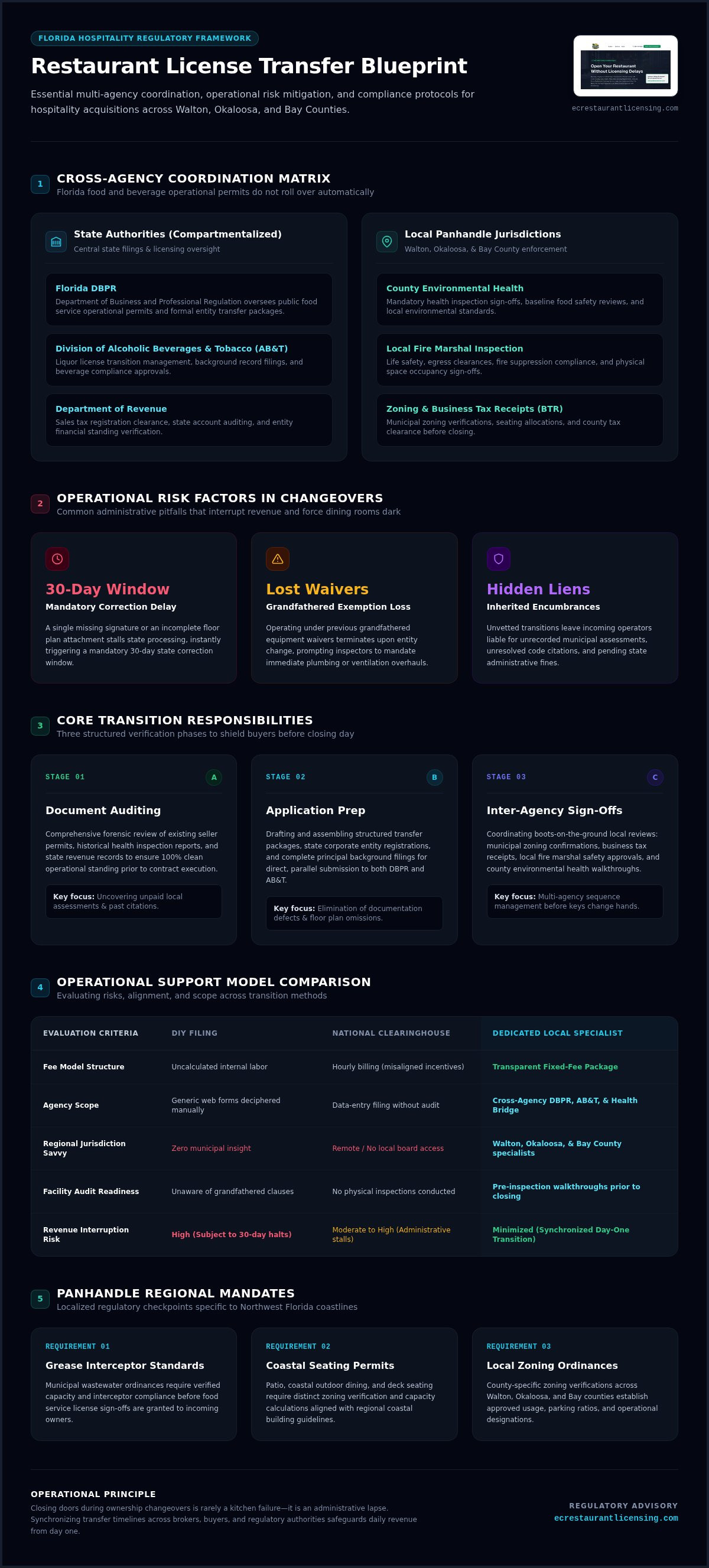
State-level filings are notoriously compartmentalized. A local consultant directly coordinates documentation across the Florida Department of Business and Professional Regulation (DBPR), the Division of Alcoholic Beverages and Tobacco (AB&T), the Department of Revenue, and county health departments. Handling the administrative complexities of a liquor license or transitioning a public food service permit requires exact sequence management. By auditing operational records well before closing, your consultant uncovers unpaid municipal assessments, unresolved code citations, or open administrative fines. Addressing these issues early prevents revenue interruption and keeps your kitchen running smoothly on day one.
Core Responsibilities in Ownership Transitions
Professional licensing consultants provide structured verification steps that shield incoming buyers from post-sale disruptions:
- Document Auditing: Reviewing existing seller permits, health inspection histories, and state accounts to confirm clean operational standing prior to closing transactions.
- Application Preparation: Drafting and submitting formal transfer packages, corporate registrations, and background filings directly to the DBPR and AB&T.
- Local Inter-Agency Sign-Offs: Coordinating necessary zoning verifications, municipal business tax receipts, local fire marshal inspections, and county environmental health sign-offs.
The Risk of Unmanaged Transfer Attempts
Attempting to manage this administrative matrix on your own frequently creates expensive bottlenecks. A single missing signature or an incomplete floor plan attachment can stall state processing, triggering mandatory 30-day correction windows that force your dining room to go dark.
Even worse, unvetted transitions often expose buyers to inherited physical deficiencies. If the previous owner operated under grandfathered equipment waivers, a change in business entity can prompt county inspectors to mandate immediate plumbing or ventilation overhauls before granting an operational permit. You can review the complete strategic breakdown for navigating a restaurant ownership change in Florida to see how early facility audits protect capital reserves. Partnering with a vetted restaurant license transfer service near me ensures these operational traps are resolved before final agreements are signed.
Key Criteria for Choosing a License Transfer Specialist Near You
Selecting the right partner requires looking beyond high-level promises. Regulatory readiness serves as the primary metric of consulting competence, determining whether an advisor can guide an establishment from the initial audit through final sign-offs without operational disruption. National legal clearinghouses and remote filing companies often treat license transfers as simple data-entry tasks. In contrast, vetting an experienced restaurant license transfer service near me ensures you partner with an advisor who understands the practical mechanics of regional health jurisdictions and state boards.
Always demand a transparent fixed-fee consulting structure. Hourly billing models create misaligned incentives during multi-agency handoffs, whereas fixed-fee packages keep the focus squarely on swift, compliant approvals. Your specialist should actively verify accounts with both the Florida DBPR and the Division of Alcoholic Beverages and Tobacco (AB&T) while conducting comprehensive pre-inspection walkthroughs long before opening day.
Regional Panhandle Experience Matters
Municipal enforcement across Walton, Okaloosa, and Bay counties carries distinct regional requirements. Local zoning ordinances, grease interceptor standards, and coastal seating permits require hands-on familiarity that remote document filers simply don't possess. A specialist with local roots coordinates directly with area inspectors, resolving technical questions before they become formal citations. Aligning with official state standards for a Florida restaurant license change of ownership means synchronizing state-level hospitality requirements with county environmental health expectations in real time.
Transparent Deliverables vs. Disjointed Expediting
Basic document runners push paperwork to state desks and disappear before field inspectors arrive. That disjointed approach leaves buyers exposed during critical on-site evaluations. A true transfer consultant delivers a structured, step-by-step roadmap tailored to your specific kitchen layout and dining footprint.
Before taking over an operating venue, confirm that the seller has compiled all prerequisite compliance documentation. Reviewing our comprehensive list of documents needed to sell a restaurant in Florida helps you establish an accurate audit baseline. For buyers seeking predictable, end-to-end guidance across every agency milestone, securing a dedicated restaurant license transfer service near me provides the clarity needed to protect your acquisition.
Comparing Support Models: DIY, General Expediter, or Local Specialist
Every restaurant buyer chooses between three distinct transition pathways: navigating the bureaucracy alone, hiring a general commercial expediter, or engaging a dedicated hospitality specialist. While self-filing appears cost-effective on paper, it often carries hidden expenses. A single rejected form can push your opening date back by weeks, leaving your newly hired kitchen crew idle while rent and utilities accumulate. Selecting an experienced restaurant license transfer service near me provides a structured approach that synchronizes operational requirements directly with your acquisition timeline.
General filing expediters manage high volumes of construction permits or standard corporate entity creations, but they frequently overlook hospitality-specific nuances. Restaurant transactions require dual-track oversight across sanitation requirements, life safety codes, and alcohol divisions. A local specialist oversees this entire sequence, auditing facility standing and managing submissions so that regulatory approvals land squarely on closing day.
The Real Bottlenecks of Self-Filing
Clerical mistakes derail self-filed transactions with alarming frequency. Missing an institutional lease signature or uploading an incorrect floor plan halts DBPR processing in Tallahassee. Even more disruptive are unresolved administrative holds. If the seller carries delinquent sales tax liabilities, the Florida Department of Revenue will freeze the application until back taxes are settled. Examining these common Florida restaurant permit delays illustrates how easily a simple oversight becomes a costly operational stall.
The Value of an Integrated Hospitality Focus
Beverage revenue frequently dictates your operating margins. Managing alcohol licensing independently demands strict adherence to Florida's official license transfer process, which requires fingerprinting, Department of Revenue tax clearances, and complete corporate disclosures. Missing any prerequisite forces your bar to sit empty while you await formal Division of Alcoholic Beverages and Tobacco processing.
Planning ahead is critical when budgeting for an acquisition. Understanding the overall capital requirements outlined in our guide on the cost of a liquor license in Florida helps you avoid cash flow surprises. When you secure a specialized restaurant license transfer service near me, you protect high-margin beverage revenue and keep front-of-house staff fully deployed from day one.
The Step-by-Step Florida Panhandle License Transfer Workflow
Executing an ownership handoff along the Emerald Coast demands a disciplined operational schedule. When buyers look for a restaurant license transfer service near me, they need a clear sequence that aligns paperwork with key transaction dates. Our team structures each transition across five deliberate stages:
- Step 1: Facility and Permit Audit: Examine active state accounts, verify historical inspection reports, and confirm the seller has zero outstanding fines.
- Step 2: Administrative Filings: Prepare state change-of-ownership submissions for the DBPR and draft required Division of Alcoholic Beverages and Tobacco filings.
- Step 3: Local Municipal Clearances: Secure municipal zoning confirmations, building department sign-offs, and grease trap sizing approvals.
- Step 4: Mock Readiness Review: Perform an on-site facility walkthrough to correct physical discrepancies before state personnel arrive.
- Step 5: Opening Inspection and Sign-Off: Coordinate the state opening inspection and secure operational authorization on closing day.
Regulatory Due Diligence and Filings
The administrative stage begins by cross-referencing existing permits against active corporate filings with the Florida Department of State. Clean entity registration is essential before state handlers review change-of-ownership packages. We verify that the outgoing operator holds a Certificate of Good Standing from the Florida Department of Revenue, confirming no unpaid sales tax follows your new entity under successor liability rules.
Submitting finalized applications through state online portals requires exact alignment between your lease agreement, legal entity structure, and facility layout plans. Even minor clerical variations can trigger formal deficiency notices that stop processing dead in its tracks.
Inspection Preparation in Walton, Okaloosa, and Bay
Regional health inspectors enforce specific physical standards that trip up unwary buyers. In coastal Panhandle communities, high ambient heat puts extreme demands on commercial refrigeration, making precise cold-holding temperatures a primary inspection checkpoint. Sanitarians will also evaluate hot water booster recovery rates and verify that grease trap interceptor servicing logs match local utility guidelines.
To avoid surprise post-closing failures, our specialists conduct detailed kitchen walkthroughs before formal field reviews take place. We inspect handwash station placements, commercial hood suppression tags, and chemical storage setups. Aligning this pre-inspection review directly with your purchase timeline guarantees that your operating permit is active the moment you receive the keys. If you are preparing to acquire an established food venue, you can schedule an initial compliance consultation with our Panhandle team to map out your upcoming transition timeline.
Securing Your Transition: Engaging a Dedicated Transfer Partner
Transitioning an active hospitality venue requires synchronized execution across commercial, administrative, and operational tracks. When communication falters between business brokers, sellers, and incoming operators, critical licensing milestones easily slip through the cracks. Engaging an established restaurant license transfer service near me bridges these gaps by establishing a central hub of administrative accountability. Rather than dealing with unpredictable hourly invoices, selecting a partner with a structured, fixed-fee consulting model provides total fiscal predictability while aligning regulatory sign-offs directly with your closing date.
Continuous compliance doesn't end when the bill of sale is executed. Maintaining ongoing operational standards requires establishing solid administrative habits that protect your business from future inspection penalties and administrative audits.
The Emerald Coast Restaurant Purchase & Transfer Package
Our dedicated Restaurant Purchase & Transfer Package provides Northwest Florida operators with a structured roadmap tailored to the regional business climate. From the initial due diligence review to final local sign-offs across Walton, Okaloosa, and Bay counties, we manage every administrative deliverable. This service includes end-to-end document compilation, state submission tracking, and inspector coordination. Operating strictly as specialized non-legal administrative consultants, our team ensures your transition satisfies every Florida DBPR and county health division requirement without administrative friction.
Actionable Next Steps for Buyers
Protecting your operating capital requires early and deliberate preparation. Before finalizing asset purchase agreements, inspect your contract to ensure regulatory contingencies align realistically with state agency review schedules. Unrealistic closing deadlines often collide with standard multi-week state processing windows, putting earnest money deposits at unnecessary risk.
Take these practical steps to safeguard your acquisition timeline:
- Audit contract language to incorporate realistic licensing contingency milestones and clear seller compliance covenants.
- Confirm the seller's state accounts have zero unresolved audit holds, outstanding departmental fees, or active health citations.
- Align your closing schedule with local health inspection availability to enable immediate operational turnover.
Partnering with a dedicated restaurant license transfer service near me early in the acquisition process protects your revenue stream, keeping your kitchen staffed and your dining room operating without missing a single day of trade.
Take the Uncertainty Out of Your Restaurant Acquisition
Taking over an established dining venue should mark an exciting new venture, not a season of regulatory anxiety. Ensuring an uninterrupted handover comes down to executing three core safeguards: auditing the seller's licensing records early, synchronizing Florida state and county filings concurrently, and completing a practical on-site inspection review before official sanitarians arrive.
Selecting the right restaurant license transfer service near me means partnering with a proven local navigator who understands municipal jurisdictions across Walton, Okaloosa, and Bay counties. Our structured Restaurant Purchase & Transfer Package eliminates administrative guesswork through predictable fixed-fee consulting, multi-agency filing management, and hands-on inspection preparation that eliminates costly opening delays. You don't have to face the regulatory maze alone. Schedule your transfer consultation with Emerald Coast Restaurant Licensing Service today to safeguard your acquisition and open with complete peace of mind.
Frequently Asked Questions
Can I keep operating an acquired restaurant while the license transfer is pending?
Yes, but only if you structure the procedural transition correctly. In Florida, food service permits don't automatically carry over to a new legal entity. Operators typically coordinate an interim operating agreement or apply for temporary operating authorization while administrative reviews are completed. Engaging a qualified restaurant license transfer service near me ensures you maintain continuous regulatory standing so your kitchen never experiences forced operational downtime.
What is the difference between a new restaurant license and a license transfer in Florida?
A new license applies to fresh build-outs or major structural conversions requiring full architectural plan reviews. A transfer or change of ownership applies when acquiring an active, operating hospitality business. Transfers utilize expedited review channels with the Florida DBPR. However, they require exhaustive regulatory due diligence to confirm the facility footprint remains unchanged and no grandfathered code variances are forfeited during the transaction.
How long does a restaurant license transfer typically take in Northwest Florida?
Transfer timelines across Walton, Okaloosa, and Bay counties generally range from three to eight weeks. Total processing duration hinges on county health department backlogs, municipal zoning approvals, and Department of Revenue tax clearances. Preparing complete administrative packets upfront prevents formal deficiency notices from state handlers in Tallahassee, keeping your transition firmly on schedule.
What happens if the previous restaurant owner has unresolved health code violations?
Unresolved health code violations transfer administrative liability directly to the new operating entity upon closing. If previous infractions remain open, state or county inspectors can deny your initial operating permit until physical remedies are made. A proper regulatory audit identifies open citations, refrigeration temperature issues, or plumbing deficiencies early, requiring the seller to rectify them before funds change hands.
Does a restaurant transfer service also handle beer, wine, or liquor license transfers?
Yes, comprehensive transfer support includes navigating alcoholic beverage filings alongside public food service permits. In Florida, transferring an alcoholic beverage license requires approval from the Division of Alcoholic Beverages and Tobacco (AB&T) and explicit clearance from the Department of Revenue. Dedicated consulting coordinates these multi-agency submissions concurrently, ensuring beverage sales continue smoothly from opening night.
Why should I hire a local licensing specialist instead of handling the filings myself?
Local specialists understand the distinct enforcement nuances of Emerald Coast inspectors and regional municipal departments. While self-filing often results in clerical rejections or missed inspection milestones, a dedicated restaurant license transfer service near me provides structured project management. This hands-on guidance removes administrative uncertainty, protects daily operating margins, and secures full compliance across state, county, and local regulatory divisions.
Does a licensing consultant provide legal representation during a restaurant acquisition?
No, licensing consultants provide non-legal administrative guidance and regulatory project management rather than legal representation. Our specialists audit municipal documentation, compile state agency applications, and coordinate physical inspection readiness. For legal advice regarding corporate asset contracts, liability structuring, or closing escrow agreements, buyers should always consult a licensed Florida hospitality attorney.