

Bay County Restaurant Permit Expediter: A 2026 Buyer’s Guide
Can a Bay County restaurant permit expediter coordinate licensing work and help prevent avoidable delays? Yes, when the project roadmap is verified and responsibilities are clear. An expediter can support paperwork preparation, submission, follow-up, and inspection readiness, but can’t guarantee approval or make decisions for the owner. A restaurant opening or ownership transfer may involve state requirements alongside reviews tied to the exact site. Applicable steps can differ between unincorporated Bay County and a municipality.
If you’re unsure which licenses, permits, or inspections apply to your operation, or concerned that inconsistent paperwork could slow a launch or transition, it helps to define the work before you begin. The right support coordinates the process while making clear which tasks the consultant handles and which remain your responsibility.
This guide explains what permitting support may include, what it doesn’t cover, and how to assess a provider’s local knowledge and service scope. You’ll also learn what to gather before requesting a consultation, so you can compare packages, confirm which agencies apply to your address and operation, and plan an organized next step.
Key Takeaways
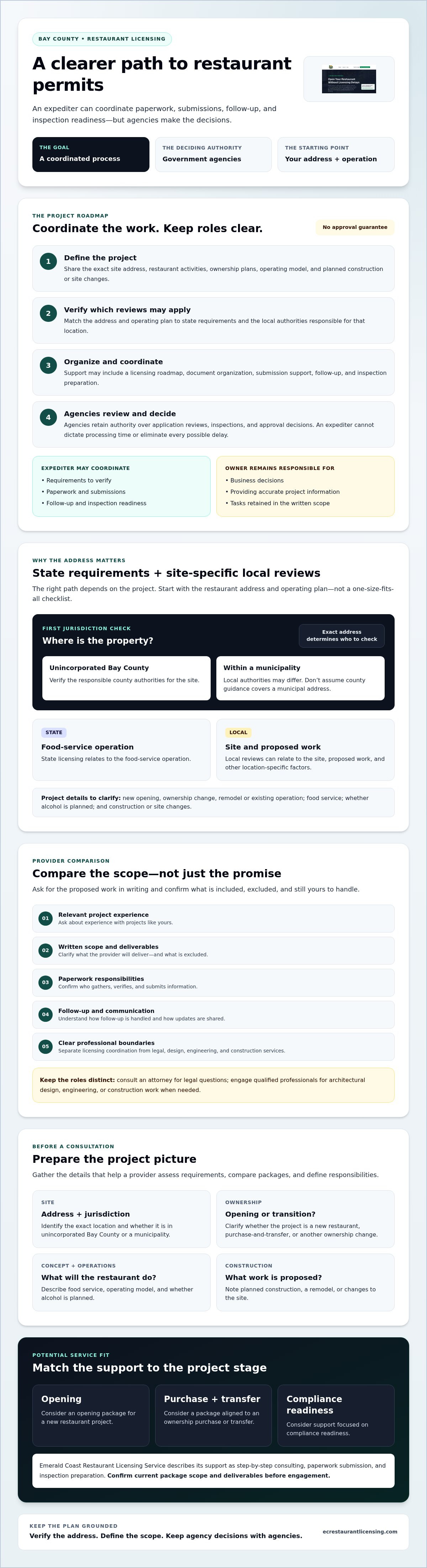
- A Bay County restaurant permit expediter can help coordinate requirements, paperwork, submissions, and inspection readiness, but government agencies make approval decisions.
- Start by matching the project address, restaurant activities, ownership plans, and construction details to the state and local reviews that may apply.
- Compare providers by project experience, written scope, expected deliverables, communication practices, and the responsibilities you’ll retain.
- Gather key site, ownership, concept, construction, and operating details before requesting a consultation.
- Explore whether an opening, purchase-and-transfer, or compliance-readiness package fits your project, then confirm its current scope and deliverables.
What a Bay County Restaurant Permit Expediter Can, and Cannot, Do
A Bay County restaurant permit expediter helps organize the administrative path for a restaurant project. That may include identifying requirements to verify, organizing documents, supporting submissions, and preparing for inspections. The goal is a coordinated process, not a shortcut around review. The restaurant owner remains responsible for business decisions and for providing accurate project information.
The work plan depends on the operation. A new restaurant, an ownership transfer, and a change to an existing business can raise different questions. The restaurant’s activities, service model, planned construction, and exact address also matter. These details help determine which agencies and local authorities to check before treating a particular license or permit as necessary.
What licensing and paperwork support may include
Consulting support may include a licensing roadmap, document organization, paperwork submission support, and inspection preparation. A business license is one example of a broad licensing concept, but that term alone doesn’t establish every requirement for a particular restaurant. Confirm the applicable requirements for the operation and site.
Before engaging a Bay County restaurant permit expediter, ask for the proposed scope in writing. Clarify which deliverables are included, who gathers and verifies information, who submits materials, how follow-up is handled, and what remains your responsibility. Ask which items are excluded, too, so you can identify when separate professionals or agency guidance may be needed. Emerald Coast Restaurant Licensing Service describes its support as step-by-step consulting, paperwork submission, and inspection preparation. Confirm current package deliverables before engagement.
When a consultant is not a substitute for an agency or specialist
Consultants can help coordinate a submission, but government agencies retain authority over application reviews, inspections, and approval decisions. An expediter can’t guarantee approval, dictate an agency’s processing time, or eliminate every possible delay. Their role is to help organize the process and surface questions that need to be addressed.
Keep professional boundaries clear. For legal questions, consult an attorney. If the project requires architectural design, engineering, or construction work, engage qualified professionals for those services. Licensing coordination is not a replacement for legal representation, design or engineering, or construction expertise.
Use the first discussion to define the project before focusing on paperwork. Share what the restaurant will do, whether ownership is changing, the site address, and any planned work. Then ask the consultant to explain what they can coordinate, what needs agency confirmation, and where another specialist should be involved. This division of responsibility gives you a clearer basis for planning without confusing consulting guidance with official approval.
How Bay County Restaurant Permits Connect to Florida and Local Reviews
A restaurant project may involve more than one review path. State licensing relates to the food-service operation, while local reviews can relate to the site, proposed work, or other location-specific factors. The right sequence depends on the project, so start with the address and operating plan rather than assuming one checklist applies to every restaurant. This is important across Bay County and in nearby Walton and Okaloosa counties, where the applicable local authorities depend on the specific project location.
Start with the restaurant address and operating model
First, determine whether the property is in unincorporated Bay County or within a municipality. The responsible local authorities may differ, so verify the jurisdiction for the exact address. The Bay County Planning and Zoning Division is a useful official reference for county planning and zoning information, but don’t assume county guidance covers a site inside a municipality.
Then describe the project clearly. Is it a new opening, a change of ownership, a remodel, or an existing operation? Note what food service the restaurant will provide, whether it plans to serve alcohol, and what construction or site changes are proposed. These details help identify which reviews to verify. They don’t establish that a particular permit or license is automatically required.
Coordinate state licensing with site-specific reviews
For applicable food-service licensing, verify requirements with the Florida Department of Business and Professional Regulation (DBPR) and its Division of Hotels and Restaurants. Local reviews are separate questions. Depending on the address and project, confirm with the relevant local building, fire, zoning, or health authority whether its review applies. Municipal boundaries and project details matter.
- Address: Confirm the jurisdiction responsible for the site.
- Operation: Describe food and alcohol service plans accurately.
- Ownership: Identify whether the business is new or changing hands.
- Construction: Explain planned work so relevant local reviews can be checked.
This project map gives a Bay County restaurant permit expediter a better basis for coordinating questions and paperwork, while leaving official determinations to the relevant agencies. For a broader overview of Florida requirements and potential delays, see this Florida restaurant permit requirements guide. If you want help organizing an opening or transition roadmap, review the consulting support from Emerald Coast Restaurant Licensing Service and confirm the current scope before engaging.
How to Compare Bay County Restaurant Permit Expediters
Choose a provider by how clearly they define the work, not by promises of a faster opening. A useful comparison shows whether the consultant understands your project type and Bay County location, how they’ll verify open questions, and what you’ll need to handle yourself. Check state licensing information with the Florida Division of Hotels and Restaurants, then ask how the provider will confirm any applicable site-specific reviews.
Use this framework to compare proposals side by side:
| What to compare | Questions to ask |
|---|---|
| Project fit | Have you worked with this type of opening, ownership change, or compliance-readiness project in Bay County? |
| Written scope | What does the engagement cover, and what is excluded? |
| Deliverables | Will I receive a roadmap, organized paperwork, submission support, or inspection preparation? Which items are confirmed? |
| Communication | How will you track documents, submission status, agency requests, and next actions? |
| Owner responsibilities | What information and decisions must I provide, and by when? |
Questions to ask before choosing a provider
Ask how the provider identifies requirements that still need confirmation. For example, who verifies which authorities apply to your address, and how will unanswered questions be handled before paperwork is submitted? Request a clear explanation of how documents and follow-up are tracked. A defined process helps you see what’s complete, what is awaiting agency input, and what needs your attention.
Also ask how the provider’s experience relates to your specific project and location. A restaurant purchase or transfer may raise different coordination questions from a new opening, so general experience alone may not demonstrate a close fit.
Warning signs in an expediter proposal
Treat guaranteed approvals or firm opening dates presented without agency confirmation as claims to scrutinize. A consultant can coordinate work, but agencies control their reviews, decisions, and processing times. A vague proposal is another concern. If it doesn’t identify deliverables, exclusions, and owner responsibilities, ask for clarification in writing before proceeding.
Check that the proposal doesn’t imply the consultant is providing legal representation, architectural or engineering design, construction, or services beyond the stated scope. The right Bay County restaurant permit expediter should explain boundaries as clearly as services. Emerald Coast Restaurant Licensing Service offers structured licensing consulting packages for restaurant openings, transfers, and compliance readiness. Review its restaurant licensing support and confirm the current scope before engaging.
What to Prepare Before Hiring a Bay County Permit Expediter
A focused project review starts with a clear account of what you know, what you’re planning, and what still needs confirmation. Preparing that picture before speaking with a Bay County restaurant permit expediter makes it easier to define the work and identify questions that need agency verification. You don’t need to assume there’s one fixed document list for every restaurant.
Information to assemble for an initial project review
- Record the site and project stage. Note the restaurant address and whether you’re planning a new opening, an ownership change, a remodel, or work at an existing operation.
- Describe the concept and operating plans. Summarize the food service, service model, alcohol plans, and intended opening plans. Mark estimates as estimates.
- Clarify ownership. Identify the current and proposed ownership structure, especially if the business is being acquired or transferred.
- Collect available project records. Depending on your situation, these may include site information, lease materials, prior licensing records, and construction details or records.
- Separate facts from open questions. Make a short list of confirmed details, assumptions, and items you need help verifying.
Missing or inconsistent information can make it harder to scope the consulting work and determine which agencies or site-specific reviews need to be checked. For example, a different address or an unclear ownership transition may change the questions that need answers. Don’t fill gaps by guessing. Flag them so the provider can distinguish what’s established from what needs follow-up.
For broader planning context, review this Florida restaurant opening roadmap. If you’re acquiring a restaurant, the Florida restaurant ownership-change guide can help frame the transition questions. Ownership-transfer consulting doesn’t replace your own permit due diligence.
Set expectations for the working relationship
Before work begins, agree on how information will move between you and the consultant. Confirm who supplies and checks documents, who is responsible for owner decisions, how updates will be shared, and how agency requests or new site-specific questions will be recorded and addressed. Ask what status updates will cover and how you’ll know when an action is waiting on you, the consultant, or an outside reviewer.
These working rules give both sides a shared reference point as the project develops. To discuss which opening, transfer, or compliance-readiness support may fit your situation, share your Bay County project details with Emerald Coast Restaurant Licensing Service and confirm the current package scope.
How Emerald Coast Restaurant Licensing Service Supports Bay County Projects
Once you’ve outlined your address, operating plans, ownership status, and open questions, match the project with a relevant consulting package. Emerald Coast Restaurant Licensing Service assists restaurant owners in Bay County, Walton County, and Okaloosa County with obtaining or transferring necessary licenses and permits. Its support can include step-by-step consulting, licensing-roadmap guidance, paperwork submission support, and inspection preparation. Confirm the current scope and deliverables of any package before engaging.
Match the project to the relevant consulting package
- New Restaurant Opening Package: For prospective owners preparing to open a restaurant. Discuss your concept, site, and project stage to clarify whether this package fits your needs.
- Restaurant Purchase & Transfer Package: For buyers and owners working through a restaurant purchase or ownership transition. This support can help organize licensing-related coordination, but it doesn’t replace permit due diligence.
- Compliance & Inspection Readiness Package: For existing operators seeking preparation support. Explain the areas where you need help so the proposed scope can be confirmed.
A Bay County restaurant permit expediter can help organize the work, but the right package depends on the project’s facts. A new opening differs from a transfer, and inspection preparation differs from determining which requirements apply to a site. Ask what the package covers, what you’ll need to provide, and which questions still require confirmation from the relevant authorities.
Make the first conversation specific and useful
Share the restaurant’s address, concept, ownership status, and current project stage. Include your intended operating plans, planned construction, and any licensing questions that remain unresolved. If you’re unsure about a detail, identify it as an open question rather than treating an assumption as confirmed. This gives the discussion a practical starting point.
The conversation can help clarify the proposed consulting scope and identify facts that need agency verification. It should also distinguish licensing coordination and inspection preparation from services Emerald Coast Restaurant Licensing Service doesn’t provide: legal representation, architectural design, or engineering. Government agencies retain authority over their reviews, inspections, and decisions, so consulting support can’t guarantee approval or control processing times.
Ready to discuss your Bay County project? Contact Emerald Coast Restaurant Licensing Service with your address, project stage, ownership status, and unresolved licensing questions to explore which package may fit and confirm its current scope.
Set Up Your Bay County Project With a Clear Plan
A well-organized permit process starts with the details: your restaurant’s address, operating model, ownership plans, and any construction scope. Those facts help clarify which state and local reviews to verify. A Bay County restaurant permit expediter can coordinate roadmap development, paperwork submission support, and inspection preparation, but government agencies retain authority over reviews and approval decisions.
When comparing support, look for a written scope that fits your project and clearly identifies deliverables, exclusions, and your responsibilities. Emerald Coast Restaurant Licensing Service offers structured consulting packages for restaurant openings, ownership transfers, and compliance readiness in Bay County, Walton County, and Okaloosa County. Confirm current package details and which authorities apply to your specific project.
Discuss your Bay County restaurant licensing project by sharing your address, project stage, ownership status, and outstanding questions. That information gives the conversation a practical starting point for identifying next steps. A clear plan helps you map responsibilities and requirements before work begins.
Frequently Asked Questions
What does a restaurant permit expediter do in Bay County?
A restaurant permit expediter helps coordinate licensing work for a restaurant project in Bay County. Depending on the operation, address, ownership, and project stage, support may include organizing a project roadmap and paperwork, assisting with submissions, and preparing for inspections. The consultant doesn’t issue permits or decide applications; the responsible agencies do. Before hiring, request a written scope that identifies deliverables, your responsibilities, and exclusions.
Do I need a restaurant permit expediter to open a restaurant in Bay County?
No. Hiring a consultant is a business decision, not a universal requirement. You can coordinate the process yourself, while professional support may help structure tasks and identify questions to verify. Check which state and local requirements apply to your specific address and operation, since the responsible authorities can vary. An expediter can’t guarantee agency processing times or ensure that your planned opening date will be met.
Which Florida agency handles restaurant food-service licensing?
For applicable public food-service licensing, check with Florida’s Department of Business and Professional Regulation (DBPR) and its Division of Hotels and Restaurants. The correct requirements depend on the operation, and state licensing guidance won’t answer every local zoning, building, fire, or other site-related question. Verify current DBPR guidance and confirm the relevant local authority for your exact Bay County address before relying on a general checklist.
Can a permit expediter guarantee restaurant permit approval or a faster opening?
No. A consultant can’t make an agency’s decision or control every review timeline. Within an agreed scope, a provider may help organize submissions, identify missing information, and prepare for inspections. Complete paperwork doesn’t remove agency review or site-specific requirements. Treat guaranteed approvals or firm opening dates as claims to verify, not dependable outcomes. Ask how the provider will communicate status and handle requests for additional information.
What should I ask before hiring a Bay County restaurant permit expediter?
Request a written scope with deliverables, exclusions, and your responsibilities. Ask whether the provider has experience with your project type and Bay County location, how they verify applicable agencies, and how they track documents, follow-ups, and next steps. Clarify communication and status updates, too. Confirm whether legal, design, or engineering work is excluded or handled by other qualified professionals. Compare the answers against your project needs.
Can a restaurant permit expediter help when buying an existing Bay County restaurant?
Yes, licensing consulting may help organize questions during a purchase or ownership transition. Don’t assume existing approvals will transfer unchanged; verify current requirements with the relevant agencies and have appropriate professionals review transaction documents. Licensing support isn’t legal representation or a substitute for brokerage advice. Emerald Coast Restaurant Licensing Service offers a Restaurant Purchase & Transfer Package as a service category. Ask about its current scope and deliverables before engaging.